Turning enquiries into patients: measure, don't keep them waiting, follow up
Published 23 October 2026Reviewed 23 October 20265 min read
On this page
What exactly does a conversion rate measure?
The conversion rate shows, as a percentage, how many of the enquiries in a period ended up as treated patients. One number alone is not enough, because people are not all lost at the same place. Measure each stage of the funnel separately and the problem shows: how many enquiries got a reply, how many completed the pre-assessment, how many got a quote, how many accepted, how many came to the appointment.
Three conditions make the numbers meaningful: every enquiry is a case in the system, every case has a source, and every loss is closed with a reason. If one is missing, the rate can be computed but you cannot tell what it depends on.
How do you measure each stage?
- Enquiry
- MeasureEnquiries by source and campaign
- Common lossA message that is never recorded anywhere
- First reply
- MeasureTime from enquiry to first reply
- Common lossA reply that takes days
- Pre-assessment
- MeasureShare of enquirers who complete the form
- Common lossA form that is long, or a photo request that is unclear
- Quote
- MeasureShare of cases quoted, and time to send
- Common lossA quote that goes out late
- Decision
- MeasureShare who accept the quote
- Common lossSilence after the quote
- Appointment and treatment
- MeasureShare who attend
- Common lossNo-shows, an incomplete travel plan
Why does first-reply time matter so much?
A prospective patient usually writes to several clinics at once and leans towards whoever gives the first meaningful reply and makes them feel understood. To build evidence of your own, measure first-reply time and compare it with conversion; do not treat someone else's statistic as your target.
There is an official floor, too: the additional performance criteria of the International Health Tourism Regulation expect 90 percent of requests to be answered within 48 hours. That is a floor, not a goal; it applies to authorised facilities, and a good clinic stays far below it. See our guide to responding to enquiries for detail.
Step by step towards better conversion
Set up one entry point
Form, phone and message enquiries all land in one list, with a clear owner.
Set a first-reply target
Choose a realistic time for your clinic and make missed cases visible to the manager.
Keep the pre-assessment short
Ask only what the quote needs; if you want photos, show how to take them.
Send the quote quickly and clearly
State what is included and excluded; make the deposit and due dates plain.
Plan the follow-up after the quote
If a sent quote is not opened in N days, a task or reminder appears, so the patient does not have to chase you.
Close losses with a reason
Use pick-list reasons such as price, timing, another clinic, no reply; select rather than type.
Look monthly
Look at conversion by source, campaign and service, and shift budget to the sources that convert.
Why are loss reasons worth so much?
“We lost it” says nothing by itself. If most losses are about price, review your quote or your audience; if most are “no reply”, the problem is the channel, not you; if most are “timing”, you need a dated follow-up plan. Picking a reason is quicker than writing one, so it gets filled in on every case.
Case board
Every case in the funnel sits at a stage
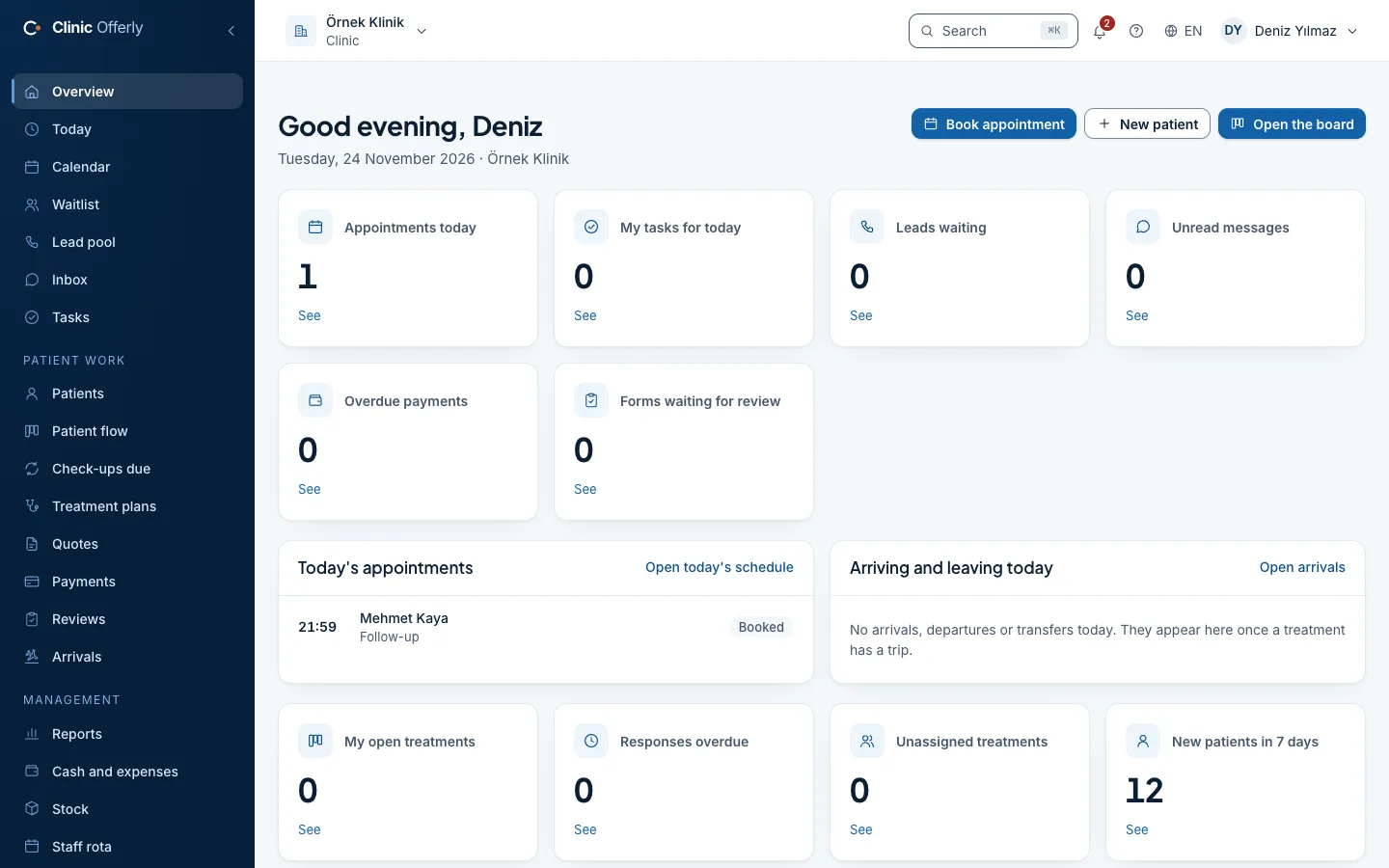
From enquiry to treatment, each case sits in a column. Waiting and overdue cases are visible to the team.
- Board by stage
- Owner and response target
- Tasks per case
Reports
Conversion by source, campaign and service
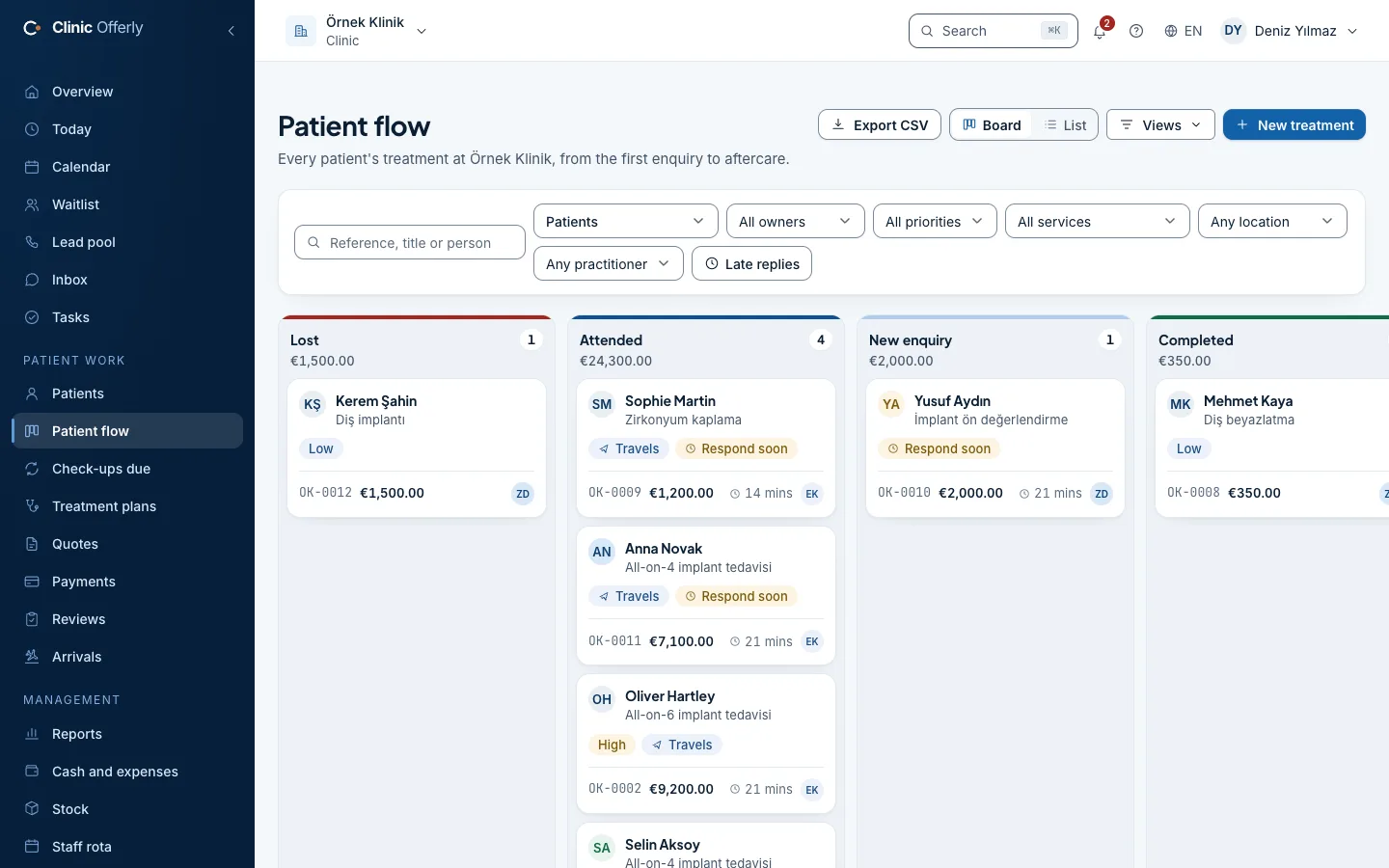
The conversion funnel breaks down by source, campaign (utm_campaign) and service; median time to first reply and to booking, and loss reasons, are in the report too.
- Source and campaign breakdown
- Median time to first reply
- No-show rate
How is this done in Clinic Offerly?
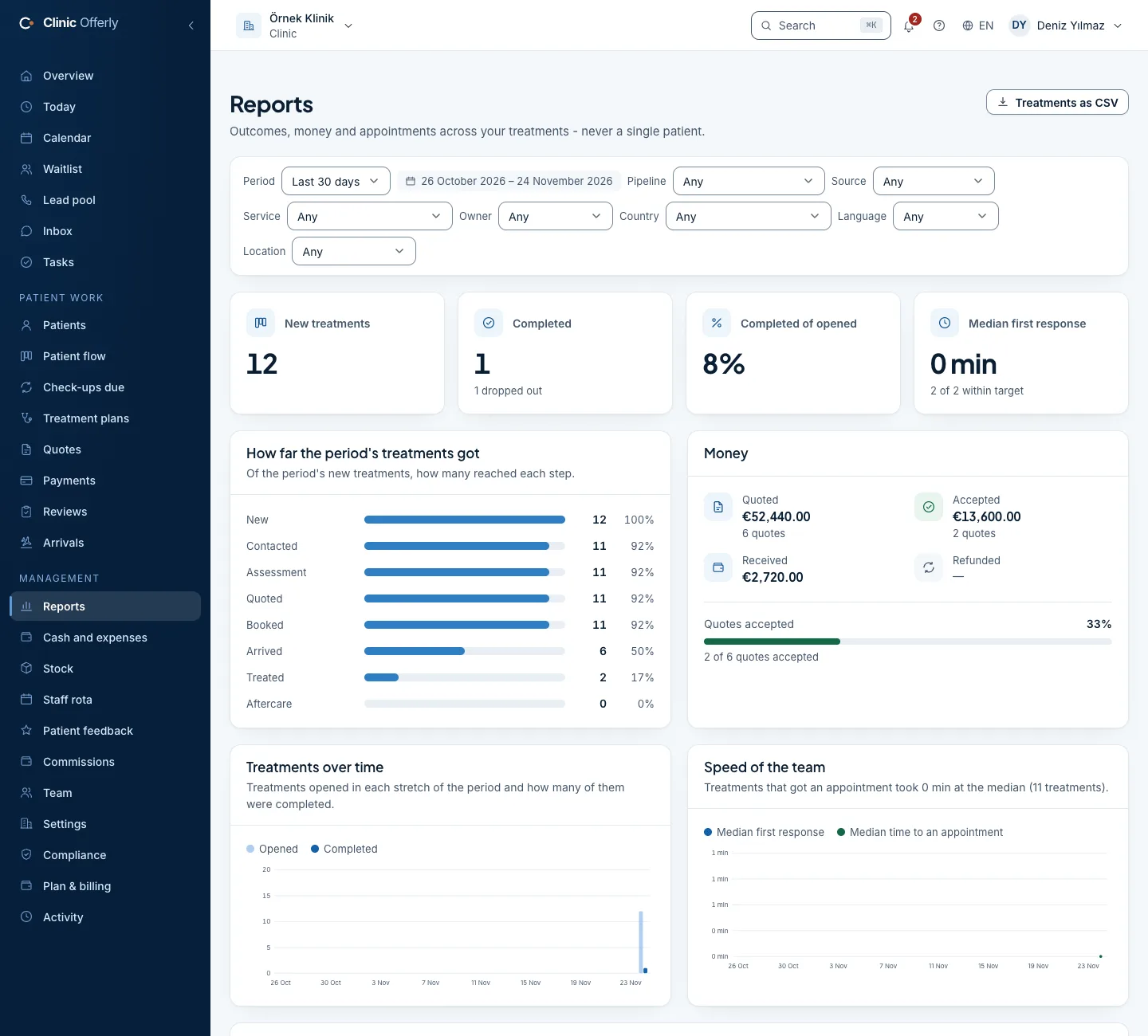
Turn the enquiry into a case
The lead form records the source and UTM data, and an assignment rule gives the case to an owner.
Response target and task
A response target is set on the case; if it is missed, the owner and manager see it.
Pre-assessment and quote
The patient gets a secure link; photos and answers stay on the case, the doctor reviews, and the quote downloads as a PDF.
A simple automation
Set a rule that opens a task or sends a message template when a sent quote has not been opened in N days.
Read the report
In reports, follow conversion by source and campaign, first-reply time and loss reasons.
Frequently asked questions
What is a good conversion rate?
There is no single right rate; it varies widely with treatment, price and source. Instead of aiming at someone else's figure, measure your own stage by stage and compare each month with your own history.
What do I need to record to measure conversion?
The source of every enquiry, the stage it is at, when the first reply was sent and, if it closed, why. Without these the rate can be computed but you cannot know what drives it.
At which stage are most patients lost?
It differs by clinic; in many teams a slow first reply and silence after the quote stand out. Do not trust a general claim before looking at your own stage losses.
Will following up on a quote annoy the patient?
Unless the patient has asked otherwise, one polite reminder is usually welcome. Marketing messages need separate permission; do not confuse a transactional message with a promotional one.
How much conversion will Clinic Offerly bring?
We do not promise a rate. Clinic Offerly helps you not lose enquiries, record the stages and measure your own conversion.
Sources
- Regulation on International Health Tourism and Tourist Health, with Annex 2 performance criteria (in Turkish) — Resmî Gazete, 26 April 2025
- [GA4] Campaigns and UTM parameters — Google Analytics Help, Current page
Related reading
Free tools
30-day free trial
Try Clinic Offerly with your own team
Every feature is open for 30 days, and no card is needed to start.