Is discussing and sharing patient information on WhatsApp KVKK-compliant?
Published 23 October 2026Reviewed 23 October 20268 min read
On this page
Why is patient information not an ordinary message?
Under Article 6 of Law No. 6698, data concerning health is special category personal data. Processing it needs either the person's explicit consent or the condition in Article 6(3): it may be processed by people under a duty of confidentiality, or by authorised bodies, for protecting public health, preventive medicine, medical diagnosis, treatment and care services, and planning, managing and financing health services. The same paragraph requires adequate measures set by the Board.
So speaking to a patient for treatment purposes can be lawful, but how you do it is a separate question. Article 12 puts the duty on the controller to take the technical and administrative measures that give an appropriate level of security against unlawful processing and access, and you are jointly responsible with anyone who processes data on your behalf. A patient thread that sits on a staff member's personal phone, outside your measures, is still your responsibility.
What has the Board said about WhatsApp?
We found no Board decision or announcement that deals with patient data and WhatsApp directly, and this page does not pretend there is one. The official texts we have are indirect, and they say the following.
In its public announcement of 29 January 2026, about public bodies using foreign-origin apps such as WhatsApp, the Authority noted that these apps have no data centre in Türkiye, that classified or critical documents should not be shared, that processing must meet the conditions in Articles 5 and 6, and that phone numbers are personal data too. The announcement is aimed at public institutions, but the logic applies to a private clinic as well: the message sits on the service provider's infrastructure, not on yours.
In its announcement of 12 January 2021 the Board said it had opened an ex officio investigation into WhatsApp LLC (decision 2021/28), and reminded the public that a service cannot be made conditional on consent, that consent can be withdrawn, and that the Article 9 conditions for transfers abroad matter.
What changed for transfers abroad?
A messaging app can send data through servers abroad. Law No. 7499 of 2 March 2024 rewrote Article 9.
- Adequacy decision
- What is neededTransfer to a country, sector or international organisation the Board has found adequate, plus a processing condition under Article 5 or 6.
- Appropriate safeguards
- What is neededAn agreement between public bodies with Board permission, binding corporate rules, a standard contract announced by the Board, or a written undertaking with Board permission.
- Standard contract
- What is neededNotified to the Authority within five business days of signing.
- Incidental transfer
- What is neededOnly for incidental transfers: explicit consent after being told the risks, performance of a contract, and similar exceptions.
What to do in which situation
- A patient writes first and asks the appointment time
- RiskLow; a short information request the patient started
- Suggested practiceReply briefly; do not bring health detail into the thread.
- Sending a report, test result or photo
- RiskHigh; special category data stays on a personal phone and lands in the gallery
- Suggested practiceSend a portal or form link; receive the file through the recorded channel.
- A group for doctors to discuss a case
- RiskHigh; identity and health data together, members change
- Suggested practiceUse a case reference instead of a name; put the group under a written rule.
- Patient and relatives in one group
- RiskHigh; information can reach someone the patient did not authorise
- Suggested practiceGet written authority to speak on the patient's behalf; prefer individual threads.
- Sending campaigns or announcements
- RiskA separate legal topic: commercial electronic messages and health promotion rules
- Suggested practiceSee the İYS and promotion guides; not this page's subject.
- A staff member left and has patient threads on their phone
- RiskHigh; you do not control the data
- Suggested practiceBusiness line and device rule; transfer and delete threads when someone leaves.
Practical rules
- Keep diagnoses, treatments, test values and photos out of the thread; leave them to the recorded channel.
- Use a separate business line where you can, and write down which staff members have access; do not use personal lines for patient threads.
- If the patient prefers WhatsApp, record that and what you told them; never make WhatsApp a condition of the service.
- Keep basic phone measures on: screen lock, automatic media saving off, remote wipe for lost devices.
- Move the information into the patient record, then delete the thread; a thread should not become an archive.
- Guard against mistakes: check that the number is current and confirm identity in the first message.
- Write an internal rule and give short training; if there is a breach, Article 12 requires you to notify the person and the Board as soon as possible.
How does the Board treat these mistakes?
Two decisions about messaging show the principle. In decision 2022/923 of 8 September 2022 the Board found that a doctor who used a patient's number, taken during an examination, to send an advertising SMS had breached purpose limitation, and fined the doctor 100,000 TL under Article 18(1)(b). In decision 2023/1787 of 19 October 2023 a Covid-19 test result went by SMS to an old number in the company's records instead of the new number the person had given; the Board treated the failure to keep the data up to date as a failure of measures, fined the controller 30,000 TL and ordered the number to be updated and the old number destroyed.
Neither case is about WhatsApp, but they show the practical risks of messaging health information: the wrong recipient and use for another purpose. The amounts are those of the year of each decision; administrative fine amounts are revalued every year.
How it is done in Clinic Offerly
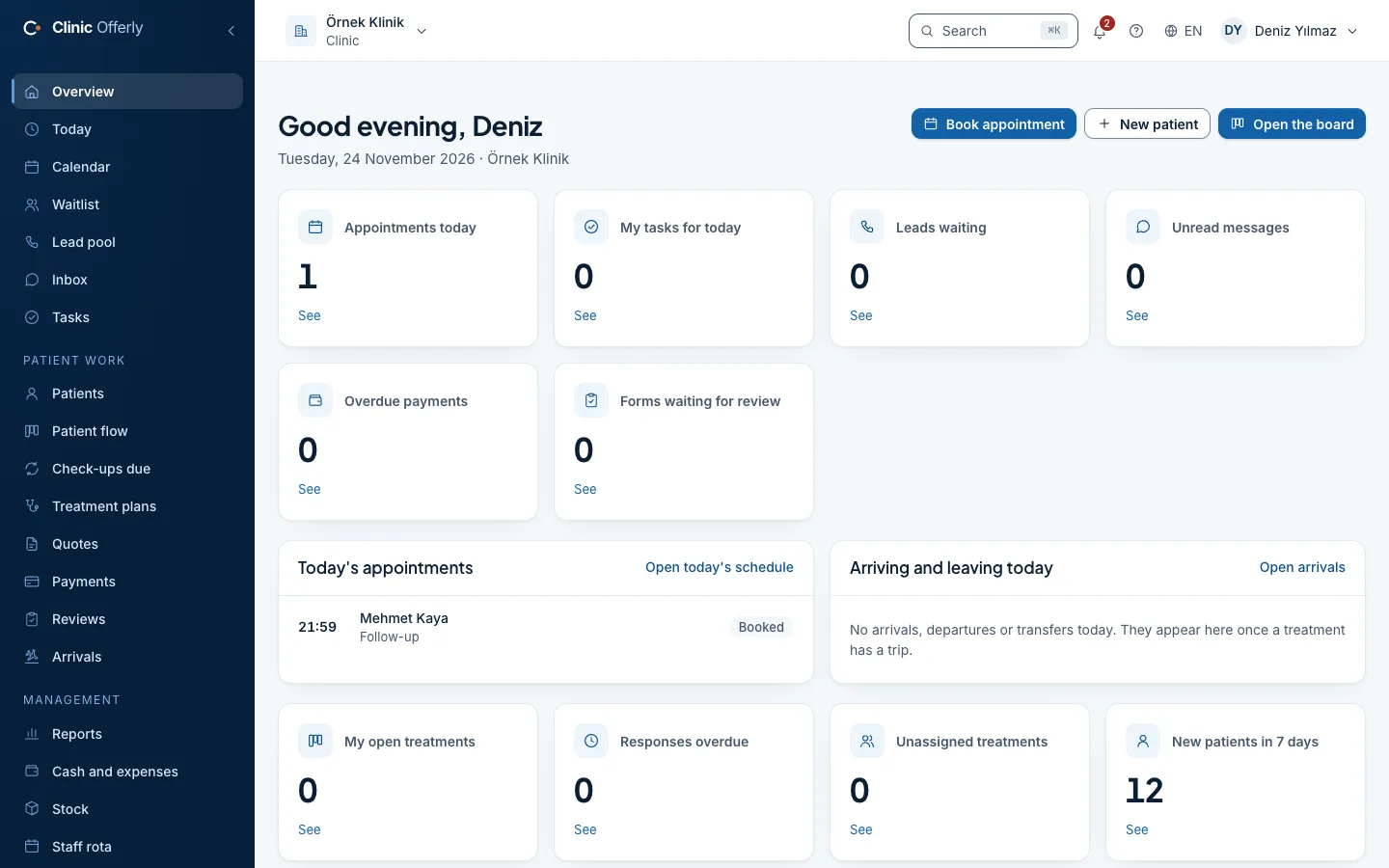
Clinic Offerly is not a messaging service and has no WhatsApp integration; the aim is for health information to stay in a recorded channel you control.
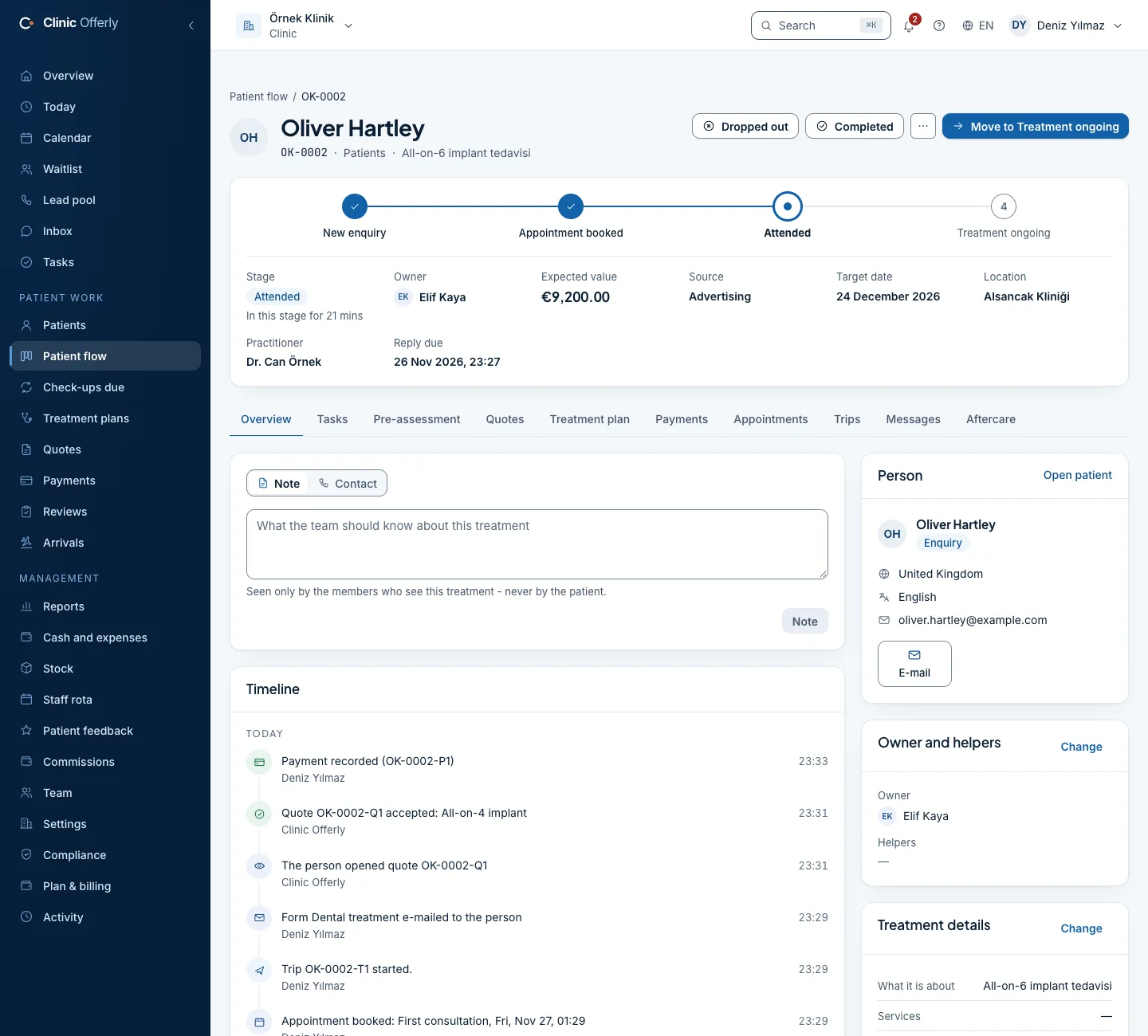
Keep the conversation inside the case
Every case has one conversation: messages between the member and the contact live under Messages in the portal, and a contact's reply notifies the member. Message bodies are kept per workspace, encrypted at field level and never written to logs.
Use e-mail only as a link
E-mails to the patient link to a portal page; the content of the message is not in the e-mail.
Receive files through the patient's portal
Reports and photos arrive through the intake form and message attachments; files are private, open through expiring links and are virus scanned.
Use WhatsApp only as a one-tap link
The contact's WhatsApp link opens WhatsApp with text prepared from a message template. Nothing passes through Clinic Offerly; you send the message yourself. Keep health detail out of the template; a case reference is enough.
Narrow access
On the Team screen set visibility per role and two-step sign-in; the activity log records who accessed what.
The conversation lives inside the case
Frequently asked questions
Is it forbidden to message patients on WhatsApp?
No; the law has no such ban. But because health data is special category, the processing condition, security measures (Art. 12) and transfers abroad (Art. 9) are assessed together. That is why it is safer not to make WhatsApp the default channel and to move health detail to a recorded channel.
May I reply if a patient writes to me on WhatsApp?
Replying to short information such as an appointment time usually causes no problem. If the patient sends a report, a photo or health detail, you become the party keeping that data on your phone; in that case send the patient a portal or form link.
Do I need the patient's explicit consent to use WhatsApp?
Do not make the service depend on WhatsApp consent; the Board's 2021 announcement reminds that a service cannot be made conditional on consent. If the patient chose the channel themselves, recording the choice and what you told them is good practice; whether explicit consent is needed depends on the data and is for your lawyer.
What do you advise for doctors' WhatsApp groups?
Use a case reference instead of a name or identity details, keep health detail out of the group, review access when members change and put the group's rule in writing. Risk rises when directly identifying data travels together.
A message went to the wrong person. What now?
If there was unlawful access, Article 12 creates a duty to notify the person and the Board as soon as possible. Record the incident, ask the recipient to delete it and assess the notification with your lawyer.
Does Clinic Offerly send messages through WhatsApp?
No. Clinic Offerly has only a one-tap link that opens WhatsApp with text from a template; the message does not pass through Clinic Offerly. Conversations run through portal messages and e-mail.
Sources
- Law No. 6698 on the Protection of Personal Data, Articles 6, 9, 12, 17 and 18 (Turkish text) — Mevzuat Bilgi Sistemi, Official Gazette, 7 April 2016; as amended by Law No. 7499
- Announcement on public bodies using apps such as WhatsApp (Turkish) — Personal Data Protection Authority (KVKK), 29 January 2026
- Public announcement on the ex officio investigation into WhatsApp LLC, decision 2021/28 (Turkish) — Personal Data Protection Authority (KVKK), 12 January 2021
- Board decision summary 2022/923 (Turkish) — Personal Data Protection Authority (KVKK), 8 September 2022
- Board decision summary 2023/1787 (Turkish) — Personal Data Protection Authority (KVKK), 19 October 2023
- Announcement on standard contracts and binding corporate rules documents (Turkish) — Personal Data Protection Authority (KVKK), 10 July 2024
Move patient conversations to a channel you keep records in
Messages, files and forms live in one case, in a record you control.
Related reading
30-day free trial
Try Clinic Offerly with your own team
Every feature is open for 30 days, and no card is needed to start.