What does a patient coordinator do? Duties, daily workflow and metrics
Published 23 October 2026Reviewed 23 October 20268 min read
On this page
Who is a patient coordinator?
A patient coordinator (also called a patient advisor or patient liaison) is the bridge between patient and team at a clinic or health tourism company. In hospitals and larger clinics the job usually sits in the international patient unit; in small set-ups the same person may also do reception.
Titles differ, but the common thread is the same: the patient talks to one person from the first message to the aftercare check, and that person works behind the scenes with doctors, nurses, finance and the transfer team. For a short definition see the glossary.
What are the duties?
- Reply to new enquiries within the target time and lead the first conversation.
- Understand the patient’s need, ask for missing details and photos, and pass the intake to the doctor.
- Prepare, or have prepared, the quote based on the doctor’s view, then send it and follow it up.
- Listen to objections (price, trust, timing) and answer realistically, accompanying the decision without pressure.
- Explain the deposit and payment plan and track payment records with finance.
- Plan the appointment and, for patients from abroad, flights, hotel and transfers together.
- Welcome the patient on arrival or organise the welcome, and follow the day.
- Send the aftercare check-ins, call those who do not answer and bring any problem to the doctor.
- Record every promise made and every contact.
What does the daily workflow look like?
This pattern is a suggestion; adjust it to your shifts and time zones.
- Start of shift
- What happensReply to overnight enquiries, check unassigned and overdue cases
- WhyThis is where first response time is lost most
- Morning
- What happensPrepare or send quotes for cases the doctor has reviewed
- WhyWaiting for a reply risks the patient going elsewhere
- Before noon
- What happensCheck appointments, flights, transfers and documents for today’s and tomorrow’s patients
- WhyProblems surface before the patient arrives
- Afternoon
- What happensFollow up sent quotes with no reply and call those whose deposit is missing
- WhyPost-quote silence is resolved here
- End of day
- What happensWrite the next step and date on every open case; prepare tomorrow’s task list
- WhyNo case is left without a next step
- Weekly
- What happensReview the numbers: response time, quote acceptance, reasons for lost cases
- WhyYou improve what you measure
Which metrics measure a coordinator?
Keep the number of metrics small and use them to see bottlenecks, not to punish people. For formulas see the clinic KPIs guide.
- First response time (median)
- What it tells youHow fast enquiries get an answer
- Watch forTreat out-of-hours enquiries separately
- Enquiries that missed the response target
- What it tells youWhether delay sits with a person or the rota
- Watch forLook at the distribution, not one person
- Quote rate and quote acceptance rate
- What it tells youWhether conversations reach a result
- Watch forSplit by service and source; source quality affects outcome
- No-show rate
- What it tells youHow firmly patients keep dates
- Watch forSplit by appointment type
- Collections
- What it tells youWhether accepted quotes turn into money received
- Watch forTrack each currency separately
- Aftercare response rate
- What it tells youWhether follow-up is kept up
- Watch forHave a rule for calling non-responders
How many patients per coordinator?
No ratio fits every clinic. What one coordinator can run depends on the treatment, the patients’ countries, the number of channels and the other work they do. Rather than trust an outside figure for “patients per coordinator”, calculate your own workload.
The calculation: multiply new enquiries per month by the average coordination minutes spent on an enquiry over its life, then add the minutes spent on older cases still running that month. Divide the total by the productive minutes one coordinator has each month, that is, working time left after meetings, breaks and admin. Do not use full paid hours.
Worked example (figures are illustrative; replace them with your own)
- New enquiries per month
- Example value120
- How to find itCount from reports or records
- Average coordination time per enquiry
- Example value90 minutes
- How to find itTime a real week, including enquiries that are lost
- Work on cases carried over from earlier months
- Example value2,400 minutes
- How to find itOpen cases × average monthly minutes per case
- Total monthly work
- Example value120 × 90 + 2,400 = 13,200 minutes
- How to find itSum of the above
- One coordinator’s productive minutes a month
- Example value6,000 minutes
- How to find itWorking time minus meetings, breaks and admin
- Coordinators needed
- Example value13,200 / 6,000 ≈ 2.2
- How to find itTotal work divided by productive time
What should you look for when hiring?
- The patients’ language and culture; test with a real correspondence sample or a short role-play.
- Clear, warm writing: how they write a first reply is the best hiring signal.
- Knowing the medical limit and being able to say “I don’t know, I will ask the doctor”.
- Order: running many open cases with their next steps.
- Respect for numbers: comfort reading metrics and keeping records.
- An advisory rather than a pushy sales attitude, with respect for patients who decide not to proceed.
A first-30-days training plan
Week 1: learn the clinic and process
Services, doctors, price structure, cancellation and deposit terms, the patient journey. Shadow real cases.
Week 2: writing and templates
Approved message templates, tone, the medical limit, data-protection and consent rules. First replies under a manager’s eye.
Week 3: quotes and follow-up
Preparing quotes, answering objections, follow-up timing. Start running their own cases.
Week 4: measurement and feedback
Reading their own metrics, reviewing lost cases, setting targets for next month.
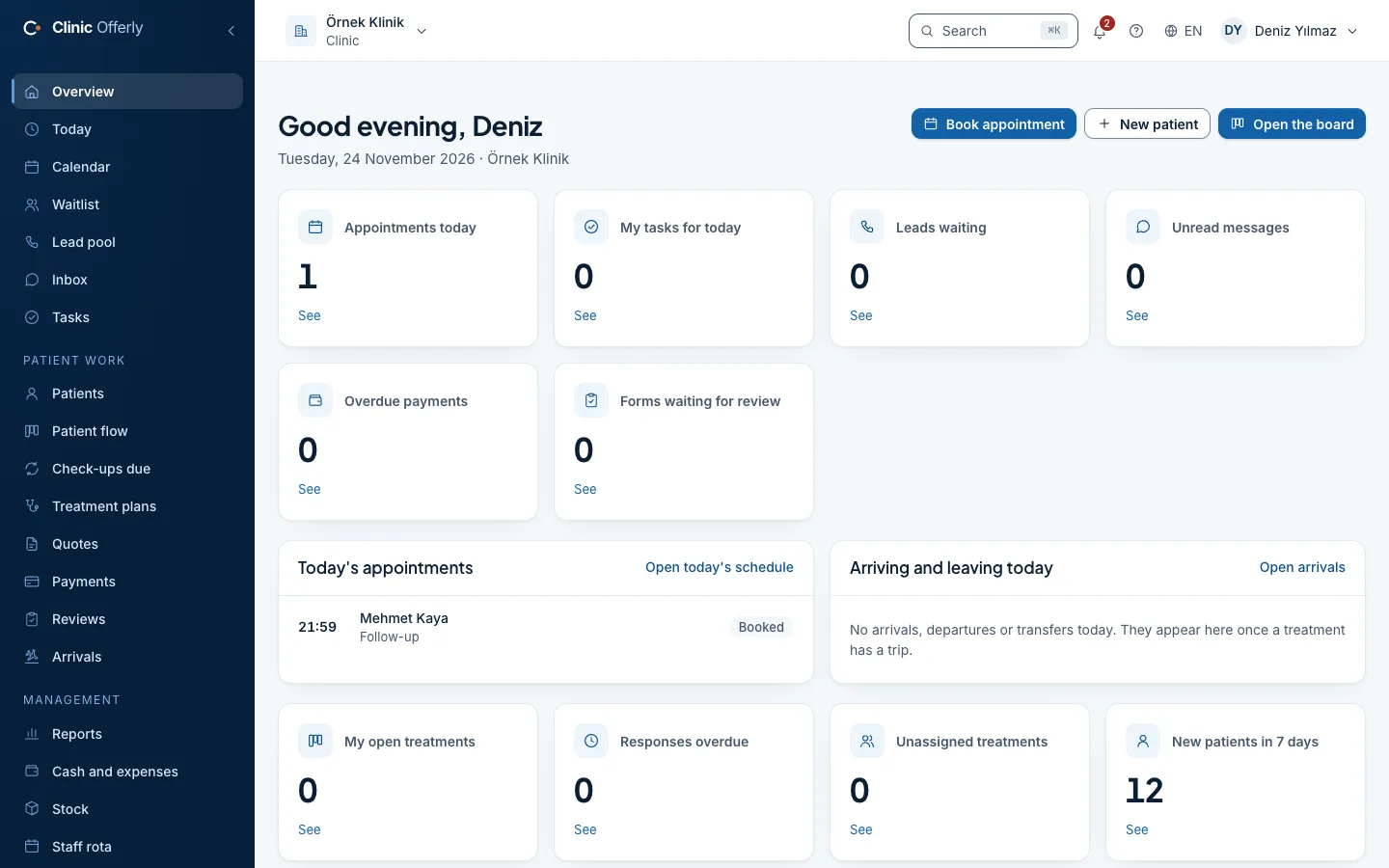
How does a coordinator’s day run in Clinic Offerly?
Start screen
The overview shows overdue replies, unassigned cases and today’s tasks first.
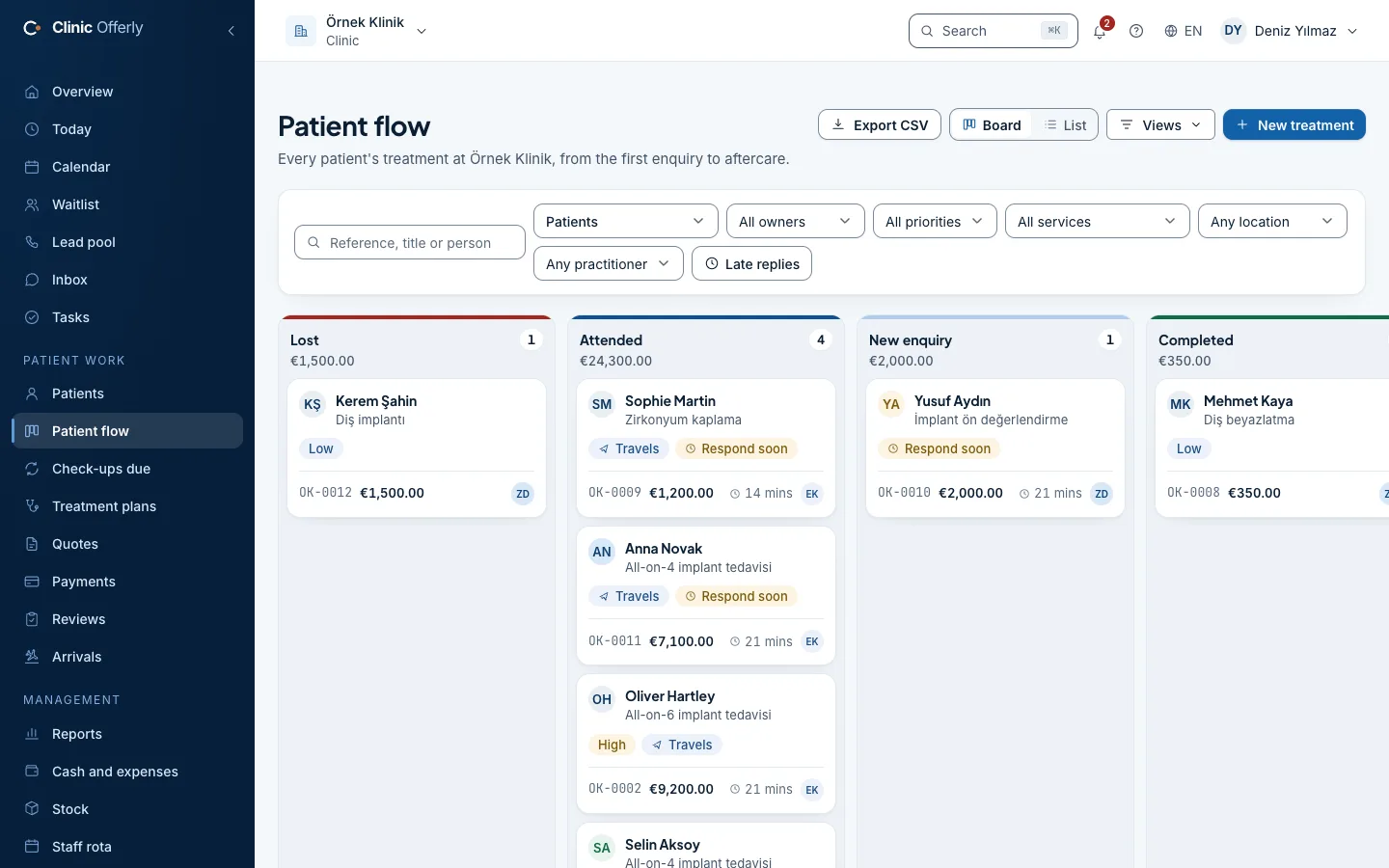
Case board and assignment
Enquiries land on the board as cases and are assigned by hand or in rotation (round-robin). As the first-response target nears, the owner is warned; if it is missed, the owner and the members who manage the team are notified.
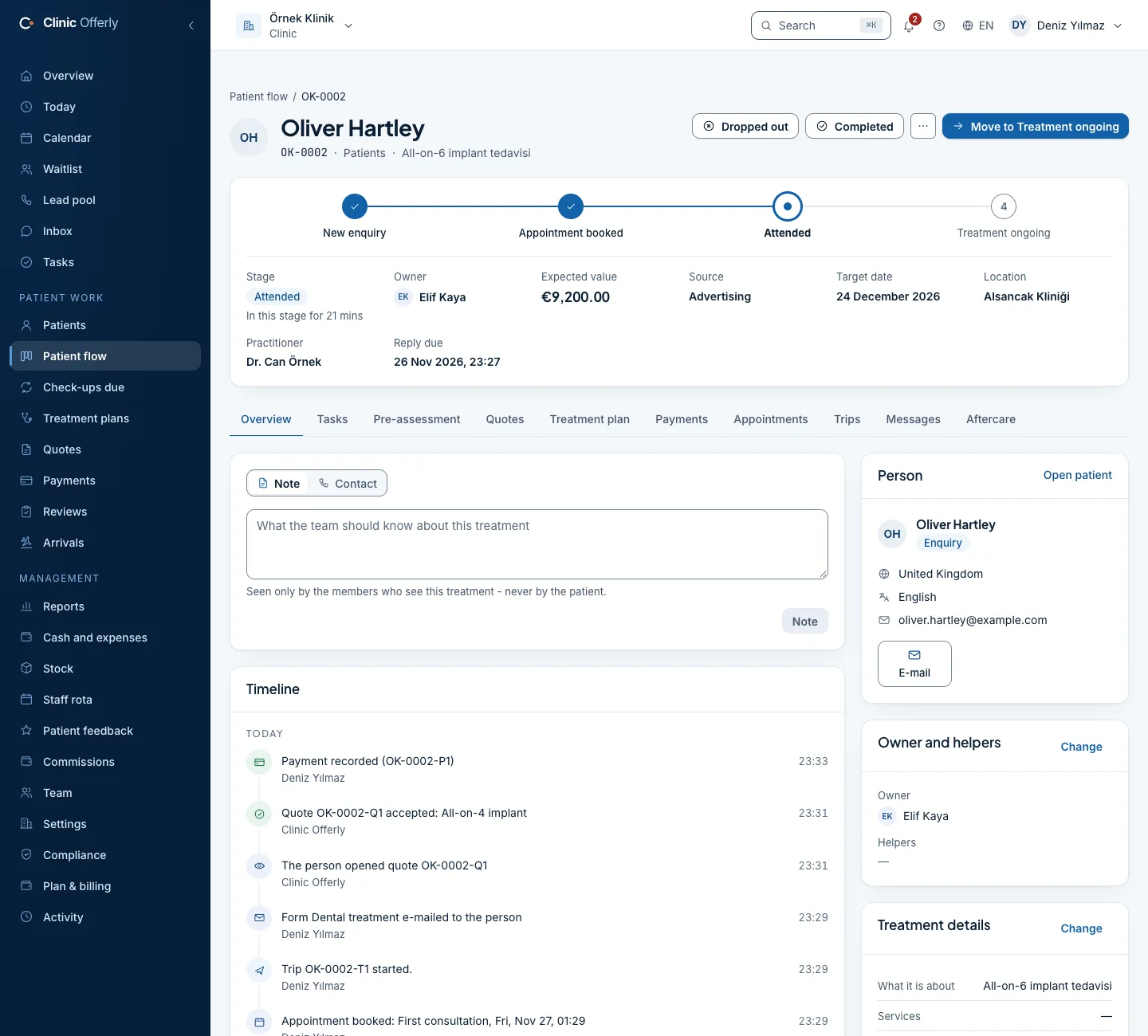
Conversation
Each case has a single conversation: portal messages and e-mail together. Templates fill in the name, clinic, reference and member; WhatsApp is a one-tap link on the contact’s record that opens with template text.
Quote and follow-up
After a quote is sent, its ‘viewed’ signal shows on the case; an automation can open a task when a quote has not been opened after a number of days.
Appointment, trip, aftercare
Appointment, flights, transfers and accommodation sit in the same case; aftercare check-ins go out by e-mail on their day and open a task.
Numbers
Reports show each member’s cases and median times; record visibility rules can restrict a coordinator to their team’s or their own records.
Frequently asked questions
Is a patient coordinator the same as a patient advisor?
In practice usually yes. The title varies by organisation; the common point is that they run communication from the first message to aftercare and make no medical decisions.
Can a patient coordinator give medical information?
No: they do not diagnose or recommend treatment. They relay the doctor’s written view and the clinic’s approved information, and pass on any question they are unsure of.
How many patients can one coordinator handle at once?
There is no fixed number. Multiply monthly new enquiries and running cases by your average coordination time and divide by one coordinator’s productive monthly minutes. The table above shows the steps.
How do you measure a coordinator’s performance?
By median first response time, enquiries that missed the response target, quote acceptance rate, no-show rate and aftercare response rate. Because source and service quality affect outcomes, compare within the same source and service.
Coordinator or software?
They complement each other. Software makes sure no case is forgotten and shows what is late; the coordinator builds the conversation and the trust.
How many coordinators does a multilingual patient base need?
Not one per language, but at least one person who can write confidently in each language. Compare your team’s languages with the spread of languages your enquiries arrive in.
Give your coordinators a case routine
In Clinic Offerly every enquiry gets an owner, a target time and a next step. 30 days free, no card needed.
Related reading
Free tools
30-day free trial
Try Clinic Offerly with your own team
Every feature is open for 30 days, and no card is needed to start.