Türkiye health tourism statistics: patients and revenue
Published 23 October 2026Reviewed 23 October 20268 min read
On this page
Patients and revenue by year
The 2019-2024 rows come from USHAŞ's Health Tourism Data page (revenue is given there in US$ thousand; converted here to millions). The 2025 row is the figure relayed from the Service Exporters' Association (HİB) in July 2026. The last column is our own calculation: revenue divided by patients.
- 2019
- Patients756,926
- Revenue (US$ million)1,459.1
- Per patient (US$, our calculation)1,928
- 2020
- Patients435,691
- Revenue (US$ million)1,371.2
- Per patient (US$, our calculation)3,147
- 2021
- Patients729,592
- Revenue (US$ million)2,016.3
- Per patient (US$, our calculation)2,764
- 2022
- Patients1,381,807
- Revenue (US$ million)2,206.8
- Per patient (US$, our calculation)1,597
- 2023
- Patients1,538,643
- Revenue (US$ million)3,006.1
- Per patient (US$, our calculation)1,954
- 2024
- Patients1,506,442
- Revenue (US$ million)3,023.0
- Per patient (US$, our calculation)2,007
- 2025 (HİB)
- Patients1,398,580
- Revenue (US$ million)3,022.5
- Per patient (US$, our calculation)2,161
What follows from the table (from the numbers themselves)
- In 2020 the number of patients fell 42.4% on the year before; the USHAŞ page itself attributes the drop to the pandemic.
- In 2022 patients rose 89.4%, and in 2023 a further 11.4% to 1,538,643, the highest figure in the series.
- In 2024 patients fell 2.1% while revenue rose 0.6%: growth came from revenue per patient, not from more patients.
- In 2025 patients look 7.2% lower than a year earlier, with revenue almost level with 2024. The only source for 2025 is HİB's statement, so do not treat this comparison as final.
- Revenue per patient went from US$1,597 in 2022 to about US$2,161 in 2025; but this is an average that lumps together very different procedures such as hair transplants and oncology.
What do these figures count, and who publishes them?
For 2019 and 2020 the USHAŞ page says the revenue comes from “foreign visitors and citizens residing abroad” who came for health and medical reasons. From 2021 the wording changes to people who came to Türkiye to receive healthcare services and the revenue from those visits. The page does not say which visitor groups are included, so the definition may not be exactly the same across the series. The page also carries no update date.
Different institutions give different numbers for the same year because their definitions differ. For example, the Ministry of Trade said in April 2024 that 1.4 million health tourists came at the end of 2023 and that health-service exports were US$2.3 billion; the USHAŞ page gives 1,538,643 patients and US$3.0 billion for the same year. Both are official bodies. If you quote a figure in a presentation or a proposal, pick one source, name it with the year, and do not mix sources.
The first 2026 figures: what is known?
The 2026 numbers come from press reports. They are not an official annual table and may change.
- January-March
- Patients302,487
- RevenueUS$761.5 million
- Reported byAnadolu Agency report quoting a HİB official, July 2026
- January-June
- Patients563,327
- Revenueabout US$1.58 billion
- Reported byDHA report, October 2026; the TÜRSAB official quoted puts revenue at US$1.5 billion
How many patients come from which countries?
In the official sources we could find, there is no patient count by country. USHAŞ's data page gives only total patients and revenue. TÜİK's Health Tourism Survey (Sağlık Turizmi Araştırması) collects data every quarter from about 3,770 workplaces to measure the health spending of foreigners and of citizens living abroad, but its results are not published (the survey's information sheet says “not published”).
Officials name markets without ranking them. The Ministry of Trade (April 2024) lists the Middle East, Germany, the United Kingdom, Russia, Azerbaijan, Kazakhstan, Turkmenistan, Uzbekistan and Afghanistan as the main places health tourists come from. A HİB official (July 2026) says patients come from about 180 countries, with Germany, the United Kingdom, Iraq, Azerbaijan, Russia, Libya and the Gulf states among the leading markets. Such lists show that a market exists, not how big it is or where it ranks.
Which treatments stand out?
There is no official count by treatment either. In July 2026 the HİB official named aesthetic and plastic surgery, hair transplants, dentistry, eye diseases, orthopaedics and traumatology, cardiology, oncology, IVF and bariatric surgery as examples, without a number for any of them. The same official said average health spending is about US$2,500 per patient and that complex treatments can cost between US$10,000 and US$50,000. The claim that about 90% of patients in Antalya's dental clinics are foreign was relayed from a TÜRSAB official; do not use it as an official measurement.
What the data does and does not say
- Total patients and revenue in 2024?
- Answer1,506,442 patients, US$3.02 billion
- BasisUSHAŞ data page
- Is there an official series for 2025?
- AnswerThe only figure we found is a trade association's statement
- BasisHİB, July 2026
- Counts by country?
- AnswerNot published; officials only name markets
- BasisMinistry of Trade, HİB
- Counts by treatment?
- AnswerNot published; only treatment names appear
- BasisHİB
- Counts by city?
- AnswerNot on the USHAŞ page; HİB says more than 40 cities offer services
- BasisUSHAŞ, HİB
- Revenue per patient?
- AnswerOnly revenue divided by patients; an average
- BasisOur calculation
- Market share or ranking?
- AnswerNo data, so it cannot be stated
- Basis-
How should you use these figures in a business plan?
A national total does not tell you the demand for your clinic or company. Do this instead:
Take one source and one year for the size of the market
One sentence is enough in a presentation: “Türkiye treated 1.5 million patients in 2024 (USHAŞ).” Do not place different institutions' numbers side by side.
Choose markets from your own data
Count how many enquiries you get from each country and how many reach a quote, an appointment and a payment. Real demand is in your records, not in the sector's totals.
Measure revenue per patient in your own services
The national average is around US$2,000; a dental implant and bariatric surgery are not the same thing. Look at collections per patient for your own treatment type.
Allow for swings
The 2020 collapse and the slight decline in 2024-2025 show that patient numbers are not guaranteed to rise. Do not tie your budget to a single growth assumption.
How do you see your own figures in Clinic Offerly?
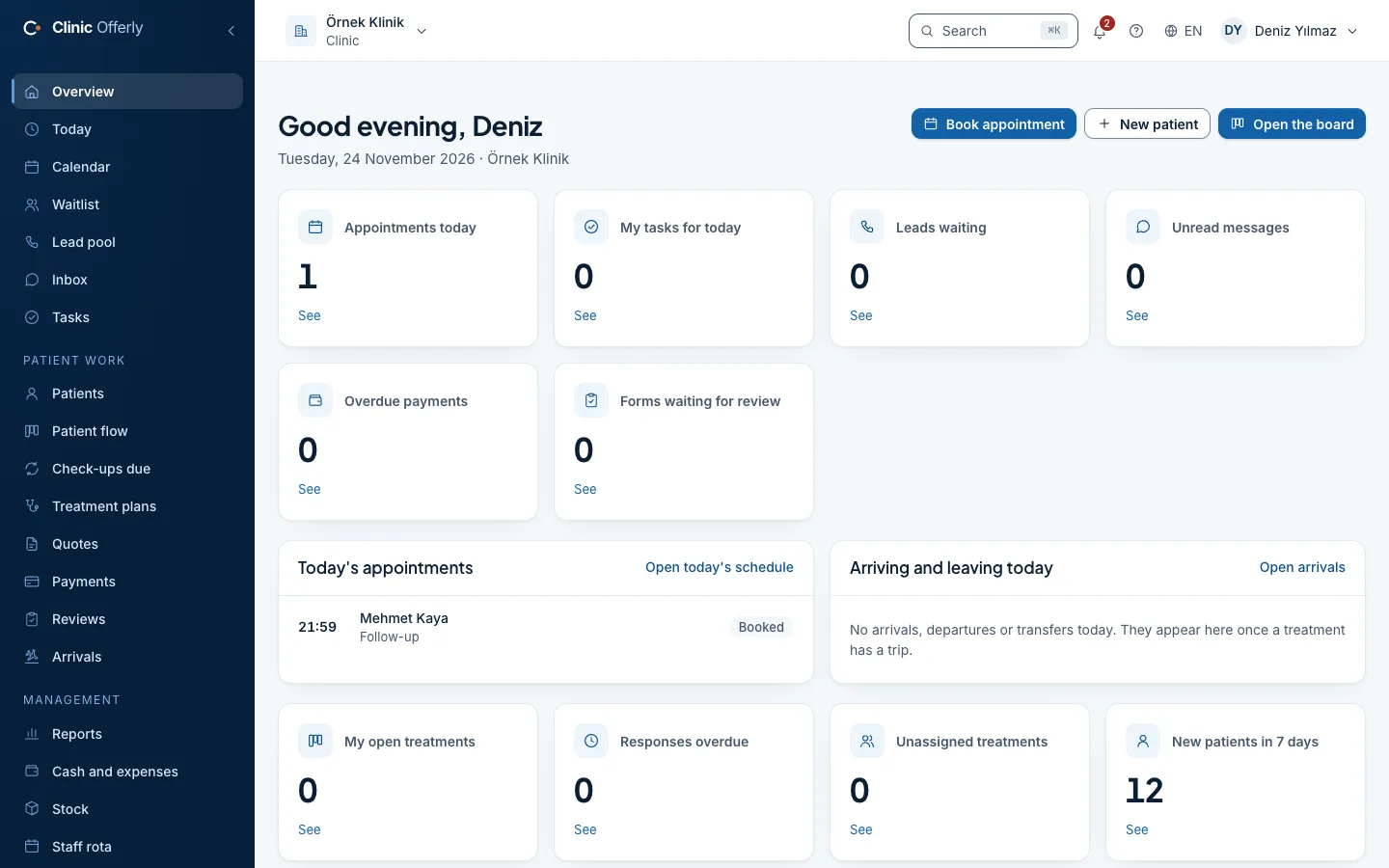
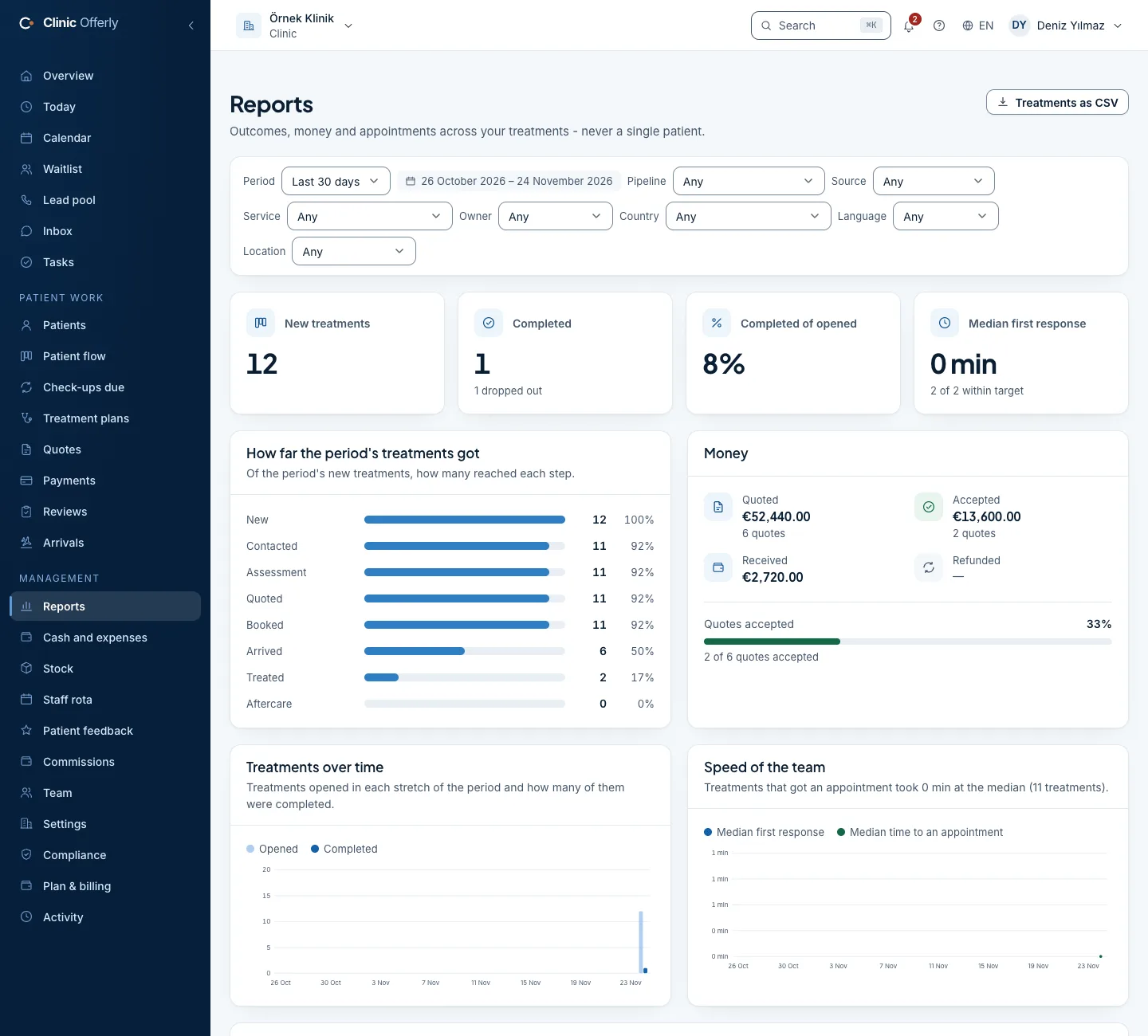
Clinic Offerly offers no country statistics; it produces reports from the records in your own workspace. The reports you can use:
Conversion by source, campaign and service
The source and campaign (utm_campaign) each enquiry came from, and the funnel from enquiry to quote, appointment and win, by service.
Trends over time
Cases opened and won by day, week or month, and the median time to first response and to booking.
Collections
Recorded collections by month and currency, the no-show rate and results by member. Clinic Offerly never holds or moves money; it only adds up the payments you record.
Frequently asked questions
How many health tourists does Türkiye receive each year?
According to USHAŞ's data page, 1,506,442 patients came in 2024 and 1,538,643 in 2023. For 2025 HİB reported 1,398,580 patients; that figure is not yet on the USHAŞ page. Because institutions define the count differently, other sources may show different numbers for the same year.
How much revenue does health tourism earn?
The USHAŞ page gives 2024 revenue as US$3,022,957 thousand, about US$3.02 billion. HİB reported US$3,022,452 thousand for 2025. The Ministry of Trade gives health-service exports of US$2.3 billion for 2023, which is a different definition.
Which countries send the most patients?
We found no reliable ranking by country. Officials name Germany, the United Kingdom, Iraq, Azerbaijan, Russia, Libya and the Gulf states among the main markets, without numbers.
Which treatments are most popular?
No official breakdown by treatment is published. Officials give hair transplants, dentistry, aesthetic surgery, eye care, orthopaedics, cardiology, oncology, IVF and bariatric surgery as examples without numbers. Be careful with websites that print rankings.
Does TÜİK publish health tourism data?
TÜİK runs a Health Tourism Survey every quarter, but its results are not published. The general Tourism Statistics bulletins are a separate study; we could not read health-related visitors directly from them, so check the tables on TÜİK's website yourself.
Is revenue per patient US$2,500 or US$2,000?
From the USHAŞ and HİB figures our own calculation gives about US$2,007 for 2024 and US$2,161 for 2025. A HİB official described average spending as about US$2,500. The gap comes from differences in definition and year; measure revenue per patient in your own services.
Measure your own demand
From the source of an enquiry to the collection, your figures in one report. 30 days free, no card.
Sources
- Health Tourism Data (patients and revenue 2019-2024) — USHAŞ, accessed 23 October 2026
- Türkiye, the global hub in health tourism (2022-2023 service exports, health tourist numbers, markets) — Ministry of Trade, 8 April 2024
- First-quarter health tourism revenue US$761.5 million (2025 totals and Q1 2026; statement by a HİB official) — Habertürk, citing Anadolu Agency, 15 July 2026
- Fewer health tourists, higher revenue per person (first half of 2026; statement by a TÜRSAB official) — MediMagazin, citing DHA, 19 October 2026
- Health Tourism Survey information sheet (STA-228) — Turkish Statistical Institute (TÜİK)
Related reading
30-day free trial
Try Clinic Offerly with your own team
Every feature is open for 30 days, and no card is needed to start.