How to set up and run an international patient unit in a hospital
Published 23 October 2026Reviewed 23 October 20267 min read
On this page
What does the regulation say about the international patient unit?
Under Article 7 of the Regulation on International Health Tourism and the Health of Tourists of 26 April 2025, a facility sets up an international health tourism unit that handles everything from admission through registration, diagnosis, treatment, billing and discharge, to interpreting and coordination with intermediaries. At least one person in the unit must have a certified foreign language, and the unit's staff details are reported to the provincial health directorate through EKİP.
The same article requires one responsible staff member in the unit for each international patient, with their details recorded on the portal. Facilities are also evaluated by USHAŞ at least once a year against the criteria in Annex 2 of the regulation (Article 9). Check the current text and annexes at the Official Gazette and the Mevzuat Bilgi Sistemi; this guide is not legal advice.
What the regulation means for the unit
- The unit
- In the regulationArticle 7: a unit handling work from admission to billing, interpreting and coordination with intermediaries
- In the unitA clear unit structure, a manager and a coordinator team
- Language skills
- In the regulationArticle 7: certified foreign language for at least one person in the unit
- In the unitLanguage certificates on the personnel file; someone covering those languages on shifts and leave
- Responsible staff
- In the regulationArticle 7: one responsible staff member per patient, recorded on the portal
- In the unitEvery case has a single owner
- Intermediaries
- In the regulationArticle 6: not using unauthorised persons for work that needs an authorisation certificate
- In the unitChecking an intermediary's certificate and keeping it on record
- Liability
- In the regulationArticle 6: facility and intermediary are liable for their services, including complications
- In the unitA record of who delivered which service
- Performance
- In the regulationArticle 9 and Annex 2: annual evaluation
- In the unitMonthly reports tracking the criteria
How is the unit organised?
- Unit manager: a manager responsible for how the unit runs, the team's plan and the reports.
- Coordinators: split by language, country or specialty; each enquiry is assigned to one coordinator, who becomes the patient's single contact.
- Doctor link: one review lead per specialty; the medical opinion comes from the doctor, not the coordinator.
- Front desk: welcome, registration, the local patient-record procedures.
- Finance: quotes and payment plans, insurer/guarantee correspondence, billing.
- Interpreters: staff or contracted; who is available in which language at what hours is written down.
- Cover and handover: a handover rule so cases are not left ownerless during leave and shifts.
How do you work with insurers and assistance companies?
The regulation is explicit on two points about insurance: complication insurance is mandatory for surgical and interventional procedures done in operating rooms (Article 6), and treatment costs from traffic accidents are billed to the social security institution, or to the patient's optional travel insurance if they have one (Article 10). It has no separate provision for assistance companies; the relationship depends on your contract.
In practice the unit should: record the patient's insurer or assistance company and policy number; request the documents the company needs (typically a doctor's report, a preliminary treatment plan, an invoice) from the doctor, with patient consent and only as far as necessary; track correspondence and any guarantee issued in the case; and tell the patient in writing in advance about any amount outside the cover. The UK Foreign Office likewise advises a person referred to a medical facility abroad to contact their insurance or assistance company promptly.
What to watch when working with intermediaries
- A facility may accept a patient who applies directly without an intermediary (Article 6).
- Do not use persons without an authorisation certificate for work that requires one; check an intermediary's certificate before working with them and keep it on record.
- Sanctions apply to a facility that takes services from an unauthorised intermediary; see the authorisation guide for details.
- Show commission and fee items for an intermediary's patient in detail in the contract and the quote.
- Give the intermediary only what its job needs; arrange sharing of medical information and documents with your legal adviser from the contract and KVKK side.
- Record who referred the patient and from which source: in reports you can measure conversion by intermediary.
Which indicators do you track?
USHAŞ's evaluation includes criteria such as patient satisfaction, response time to enquiries, appointment waiting time, complaints and turnover (Article 9 and Annex 2). On your own dashboard, track:
- First response time: from enquiry to first reply, by country and language.
- Conversion between stages: enquiry, doctor review, quote, acceptance, arrival.
- Doctor review waiting time, per specialty.
- Enquiries and acceptances by source and intermediary.
- Number of complaints and aftercare questions, and closing times.
- Quotes and collections by currency.
How do you measure and improve the patient experience?
At every stage the patient should know the next step and whom to contact: enquiry, assessment, quote, arrival, treatment, return. The unit does that by showing it in one portal, in the patient's language and in local time.
A short satisfaction question after treatment and a closing call do two jobs: they show you value the patient, and they leave you with concrete data on the regulation's criteria. Keep complaints linked to the case and record the solution and how long it took.
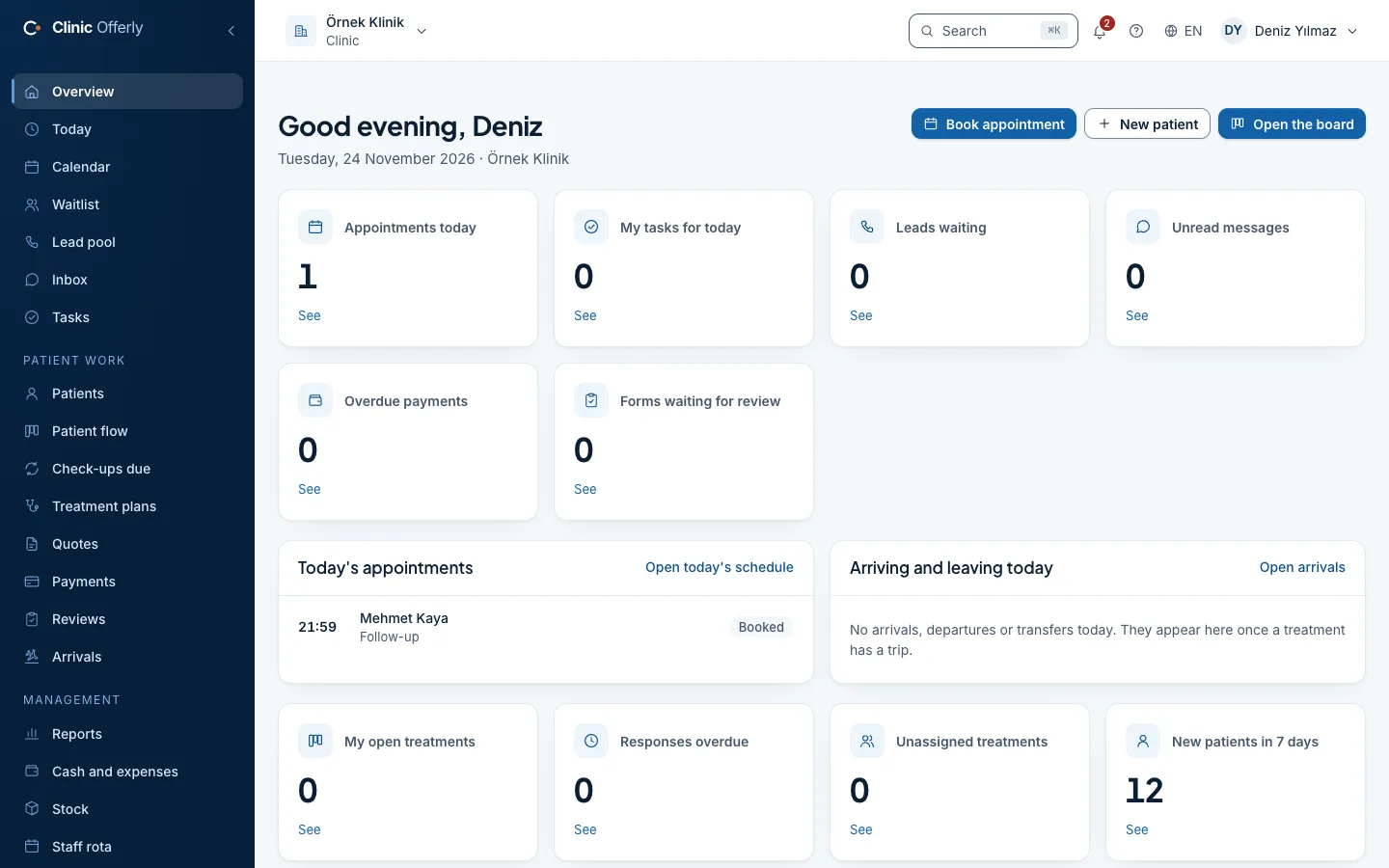
How does the international patient unit run in Clinic Offerly?
Clinic Offerly does not replace the HIS and keeps no medical records; it runs the unit's patient relationship and logistics.
Enquiries go to the coordinator by language
An enquiry becomes a case with its source and is assigned to the next coordinator by language, country, source or service; missed response targets are visible.
Doctor review in a queue
Intake answers and photos land in the doctor's review queue; with teams and visibility rules each team sees only its own cases.
Quote, trip and arrivals board
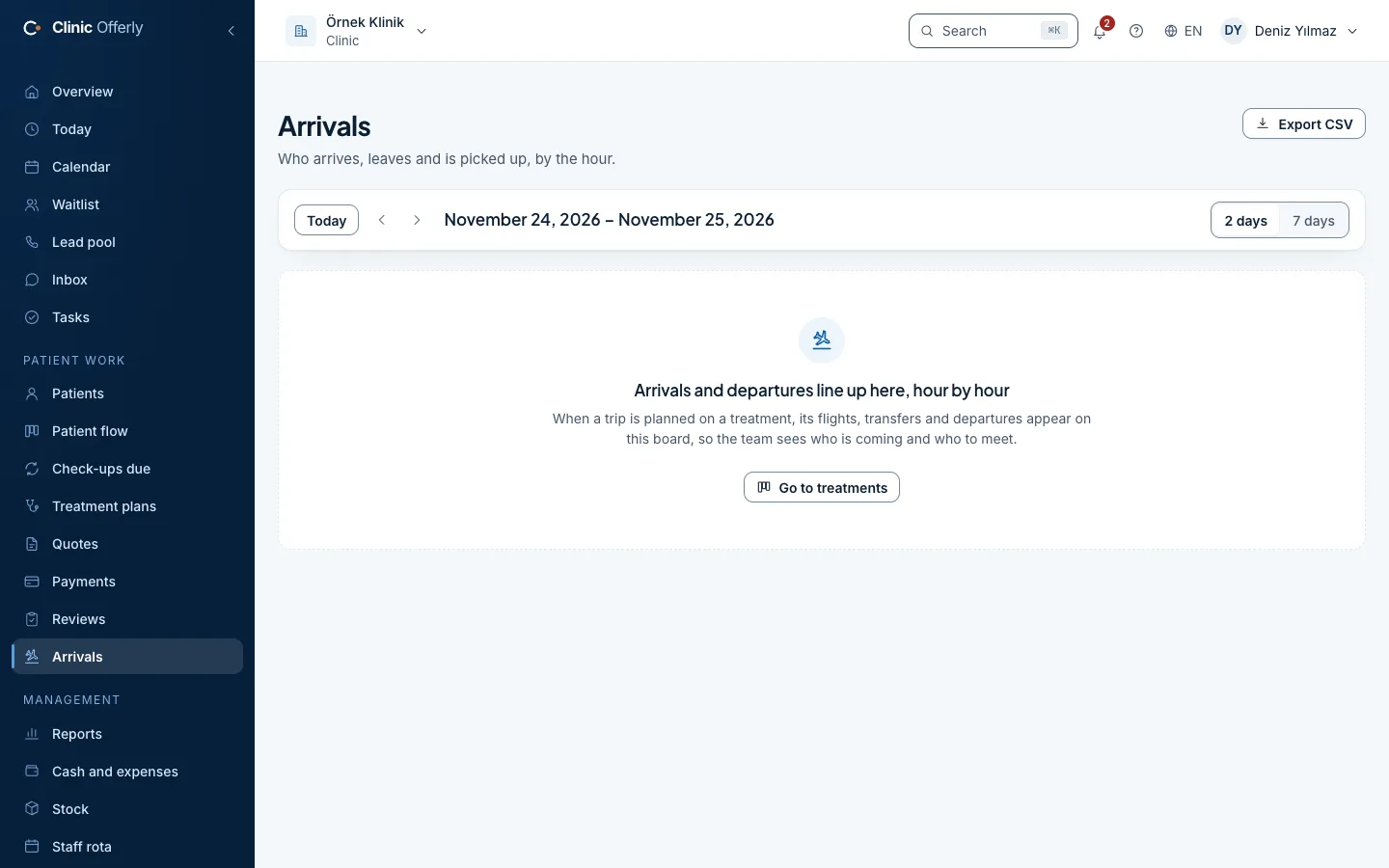
Quotes are issued by currency and the patient accepts in the portal. Flights, hotel, transfers and interpreter arrangements go into the trip; the front desk starts the day with the arrivals board. Partners are recorded with their documents, and an intermediary whose certificate is unchecked triggers a warning.
Reports and access
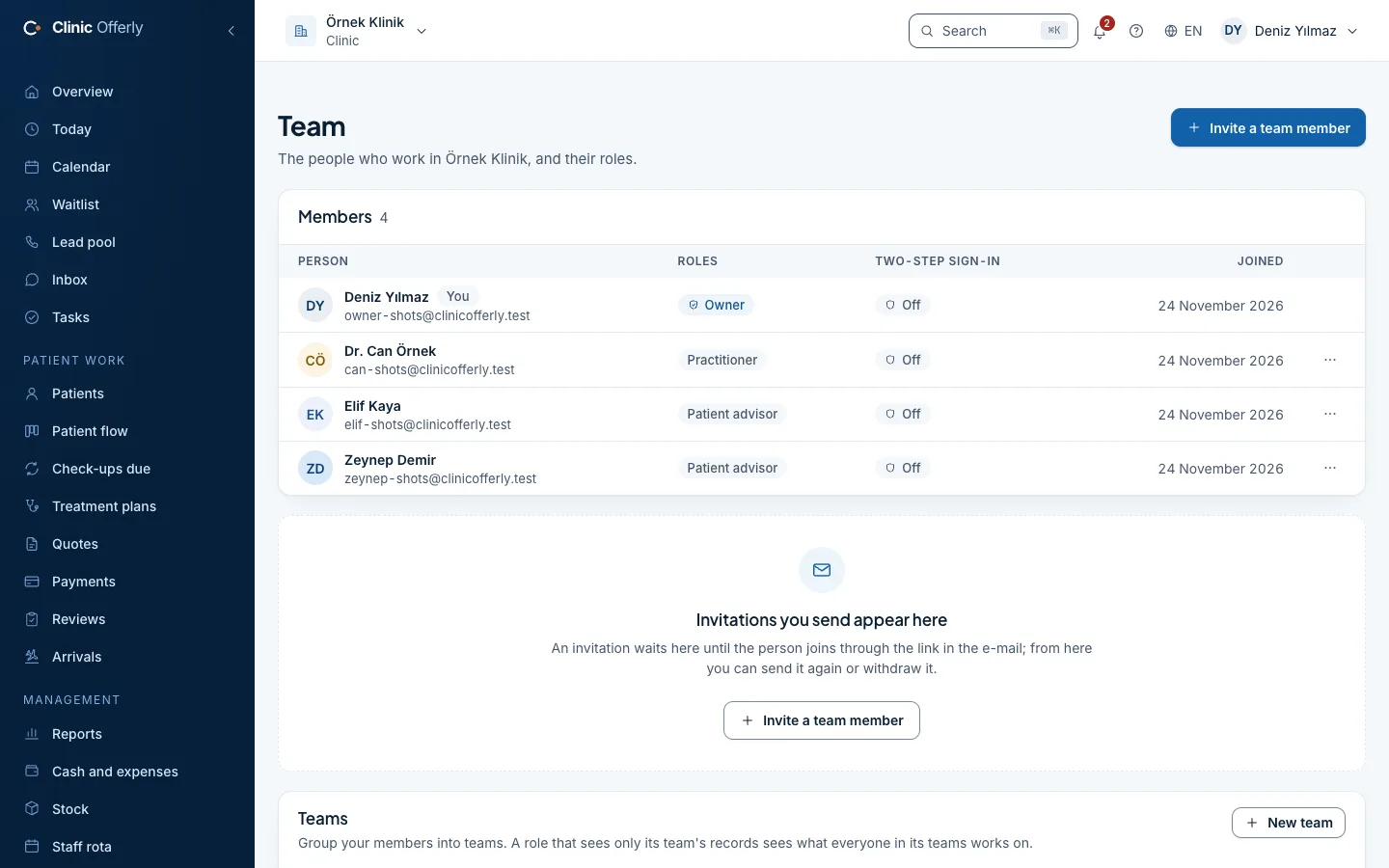
Reports by country, language, source, service and owner; nine fixed roles; activity log and two-step sign-in.
Morning
The front desk starts the day with the arrivals board
Flights landing today and tomorrow, welcomes and transfers, sorted by local time.
- Number of passengers and responsible coordinator
- Confirmed and pending transfers
- Treatment days and appointments
Trips, transfers and accommodation
Management
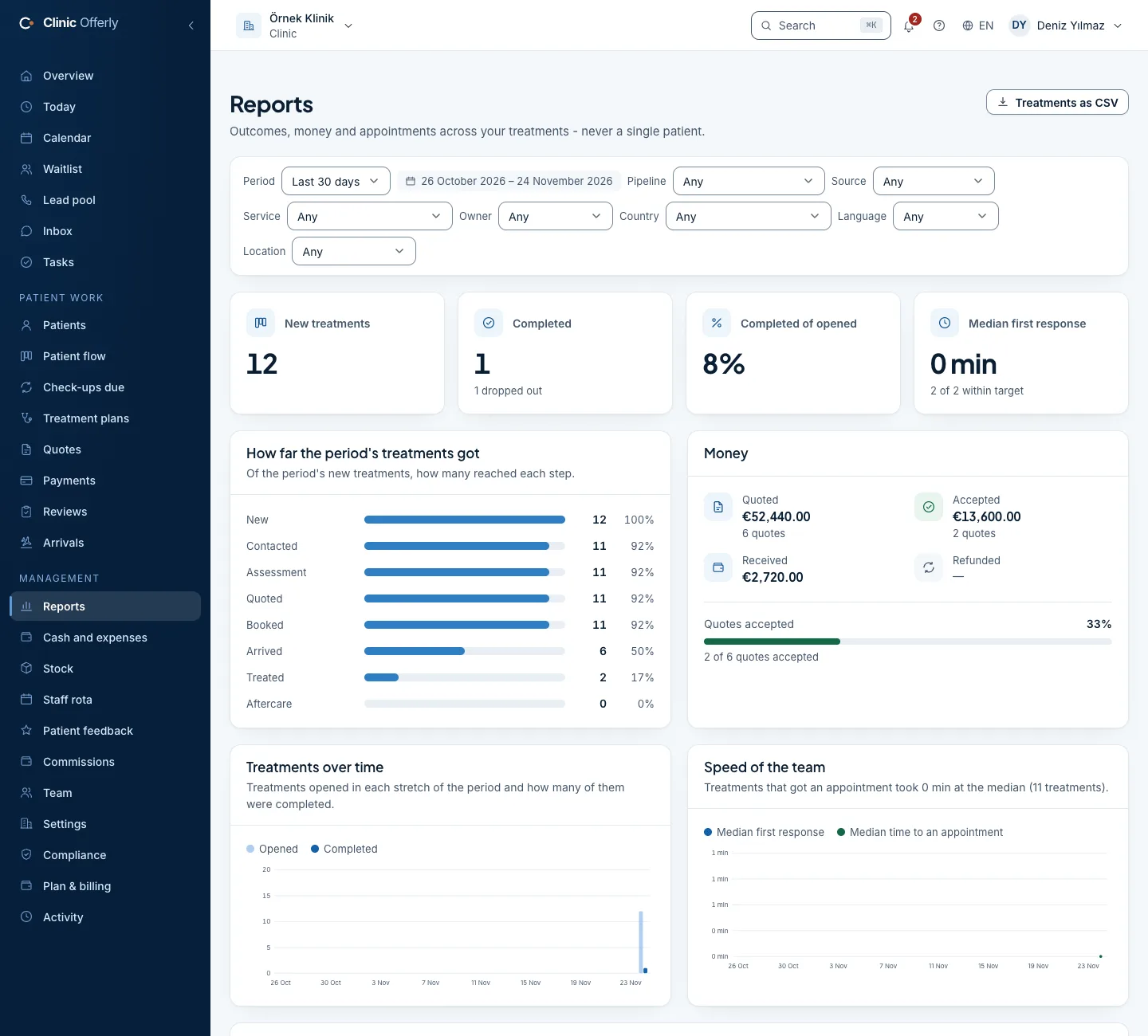
Numbers by country, source and coordinator
Cases opened, won and lost; first response times; quotes and collections by currency.
- Missed response targets
- Appointments by location
- Case CSV
Try it for your unit
Open a hospital workspace; domestic and international processes, forms and KVKK texts come ready. Ask for a demo for large units.
Frequently asked questions
Does a hospital have to set up an international patient unit?
Yes, for facilities that take patients from abroad under an authorisation certificate. Article 7 of the 2025 regulation requires an international health tourism unit handling everything from admission to billing and interpreting.
Must the unit have an interpreter?
The regulation expects the unit to handle interpreting and requires at least one person in the unit to have a certified foreign language. How many interpreters you need and in which languages depends on your patient mix; confirm the current requirement against the regulation and your provincial health directorate.
Do we need a separate responsible staff member for each patient?
Yes. The regulation requires one responsible staff member in the unit to be designated for each international patient and recorded on the portal. A single owner per case in your workflow satisfies this in practice.
Does the regulation set special conditions for working with assistance companies?
It has no separate provision for assistance companies. The relationship depends on your contract; the complication insurance requirement and the rules on traffic accidents and optional travel insurance are in the regulation.
Can we accept patients without an intermediary?
Yes. The regulation allows a patient who applies directly to be accepted without an intermediary. If you work with an intermediary, choose one with an authorisation certificate.
Does Clinic Offerly connect to our HIS?
No. Medical records stay in your HIS; Clinic Offerly handles enquiries, quotes, trips, follow-up and reporting.
Sources
- Regulation on International Health Tourism and the Health of Tourists, Articles 6, 7, 9, 10 and Annex 2 (in Turkish) — Resmî Gazete, no. 32882, 26 April 2025
- Current text of the regulation and notes (in Turkish) — Mevzuat Bilgi Sistemi
- Turkey travel advice: Health — Foreign, Commonwealth & Development Office (GOV.UK)
Related reading
30-day free trial
Try Clinic Offerly with your own team
Every feature is open for 30 days, and no card is needed to start.