Patient recall: how to plan check-ups and repeat appointments
Published 23 October 2026Reviewed 23 October 20267 min read
On this page
What is patient recall and why does it matter?
After a consultation the practitioner suggests a check-up interval: “in six months”, “in three months”, “when the results are in”. That sentence often ends up in nobody's diary. The patient forgets, the clinic does not remember, and a year later neither knows why the visit was missed.
Recall closes that gap: the decision is recorded, the patient is told when it is due and the reminder becomes a booking. For the patient it is continuity of care; for the clinic it is the cheapest filled appointment there is. The right interval varies by patient, treatment and specialty; a figure such as “six months for dental” is not a rule for your clinic, it is the dentist's decision.
Who gets recalled?
These types are examples. The practitioner sets the interval for each patient; the table has no figures.
- Planned check-up
- Who sets the intervalPractitioner
- What to look for in the listLast visit date plus the interval the practitioner gave
- Post-treatment check
- Who sets the intervalPractitioner
- What to look for in the listTreatment date plus the day in the treatment plan
- Patient awaiting results
- Who sets the intervalPractitioner and lab turnaround
- What to look for in the listDate the test was requested
- Unfinished treatment
- Who sets the intervalPractitioner
- What to look for in the listA planned session with no appointment booked
- Patient not seen for a long time
- Who sets the intervalClinic
- What to look for in the listTime since the last appointment
A weekly recall routine
Record the decision
When the visit ends, write the interval the practitioner gave on the patient's record as “check-up on this date”, or as a task. Do not leave it in a diary or in memory.
List who is due once a week
Pull out patients whose check-up falls in the next two weeks and who have no appointment. One person should own this list.
Send a message about their own care
Short, polite, asking for one step, with a booking link.
Call those who do not reply, once
A few days after the message, reach them once more by phone or the channel they use; do not keep pushing.
Record the outcome
Booked, wants to postpone, continuing elsewhere or asked not to be contacted again: write it down with the reason.
Information or promotion?
A recall message about the patient's own care is the general case, but once the content turns promotional the rules change.
- Care reminder
- Example“The check-up your doctor suggested is due. You can pick a time at the link.”
- Watch forThe patient's own appointment and care; no price, discount or campaign
- Promotion
- Example“20% off check-ups this month!”
- Watch forPromotion with prices, discounts and campaigns is banned domestically; commercial messages also need consent
- Mixed message
- ExampleReminder plus an announcement of a new service
- Watch forDo not mix: the promotional part can make the message commercial
Message examples (EN)
Keep them about the patient's own care: no prices, discounts or campaigns.
- Planned check-up: “Hello {name}, this is {clinic}. The check-up you planned with {practitioner} is coming up. You can pick a time here or call us: {link}”
- After treatment: “Hello {name}, we cannot see an appointment for your check-up after your treatment on {date}. Would you like us to help?”
- After results: “Hello {name}, once your test results are ready you can book a time with your doctor here: {link}”
- Patient we have not seen for a while: “Hello {name}, we have not seen you for a while. If you like, we can set aside a time for a check-up; if not, just reply to say so.”
Mesaj örnekleri (TR)
Mesajlar hastanın kendi bakımıyla ilgili kalsın; fiyat, indirim ya da kampanya koymayın.
- Planlı kontrol: “Merhaba {ad}, {klinik}. {hekim} ile planladığınız kontrol zamanı yaklaştı. Size uygun saati şu bağlantıdan seçebilir ya da bizi arayabilirsiniz: {bağlantı}”
- Tedavi sonrası: “Merhaba {ad}, {tarih} tarihli işleminizden sonraki kontrolünüz için randevu henüz görünmüyor. Yardımcı olmamızı ister misiniz?”
- Sonuç sonrası: “Merhaba {ad}, tahlil sonuçlarınız hazır olduğunda hekiminizle görüşmek için randevu alabilirsiniz: {bağlantı}”
- Uzun süredir görmediğimiz hasta: “Merhaba {ad}, sizi bir süredir görmedik. İsterseniz kontrol için bir saat ayırabiliriz; istemezseniz bu mesajı yanıtlamanız yeterli.”
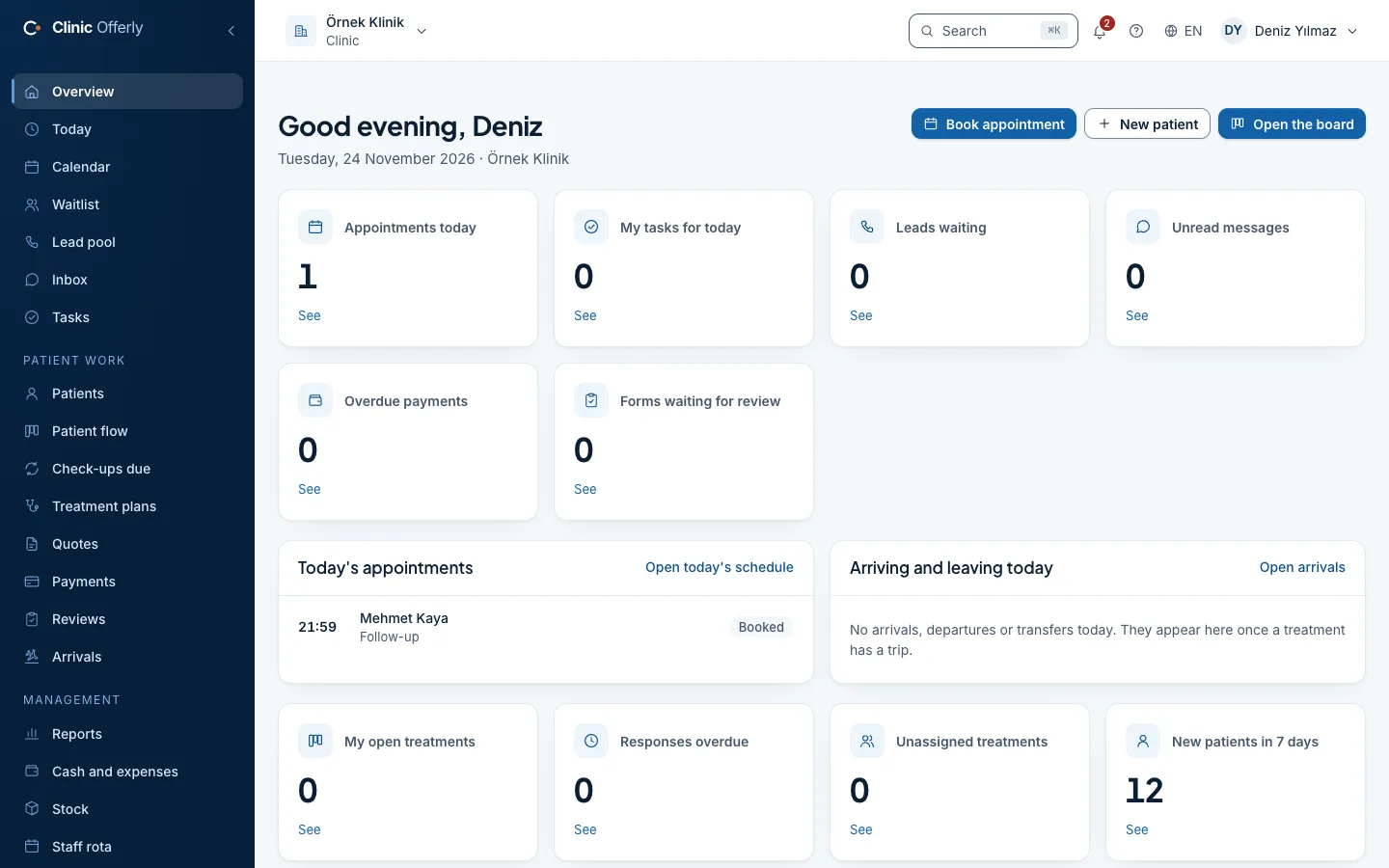
How do you do it in Clinic Offerly?
In Clinic Offerly the Recalls screen runs this routine; it sends no promotion, only information about a service the patient has had.
A check-up interval on the service
In Settings → Services you give a service a check-up interval in months. When an appointment is completed, the patient's recall falls due after that interval; those due or overdue are filtered by state, service, practitioner and location on the Recalls screen.
Bulk reminders and tasks
Send a reminder to the people you select in one go, or open a call task on the case for each. The reminder is an informational message; it goes through the contact's channel (e-mail, or SMS or WhatsApp if connected) and carries your booking page link. An automation rule can also create a task when a recall falls due.
A booking-page link
The patient picks their own time from the link in the reminder; once they book, the recall becomes Booked on its own.
Calling and WhatsApp
Reach a patient who has not replied through the one-tap call or WhatsApp links on the contact's record; log the call as an activity with its outcome, and open a call-back task if you wish.
Marketing consent
A contact's marketing consent and, in Türkiye, İYS status are recorded; use the messages as information, not promotion. Clinic Offerly does not upload consent to İYS, and there are no birthday or periodic greeting messages.
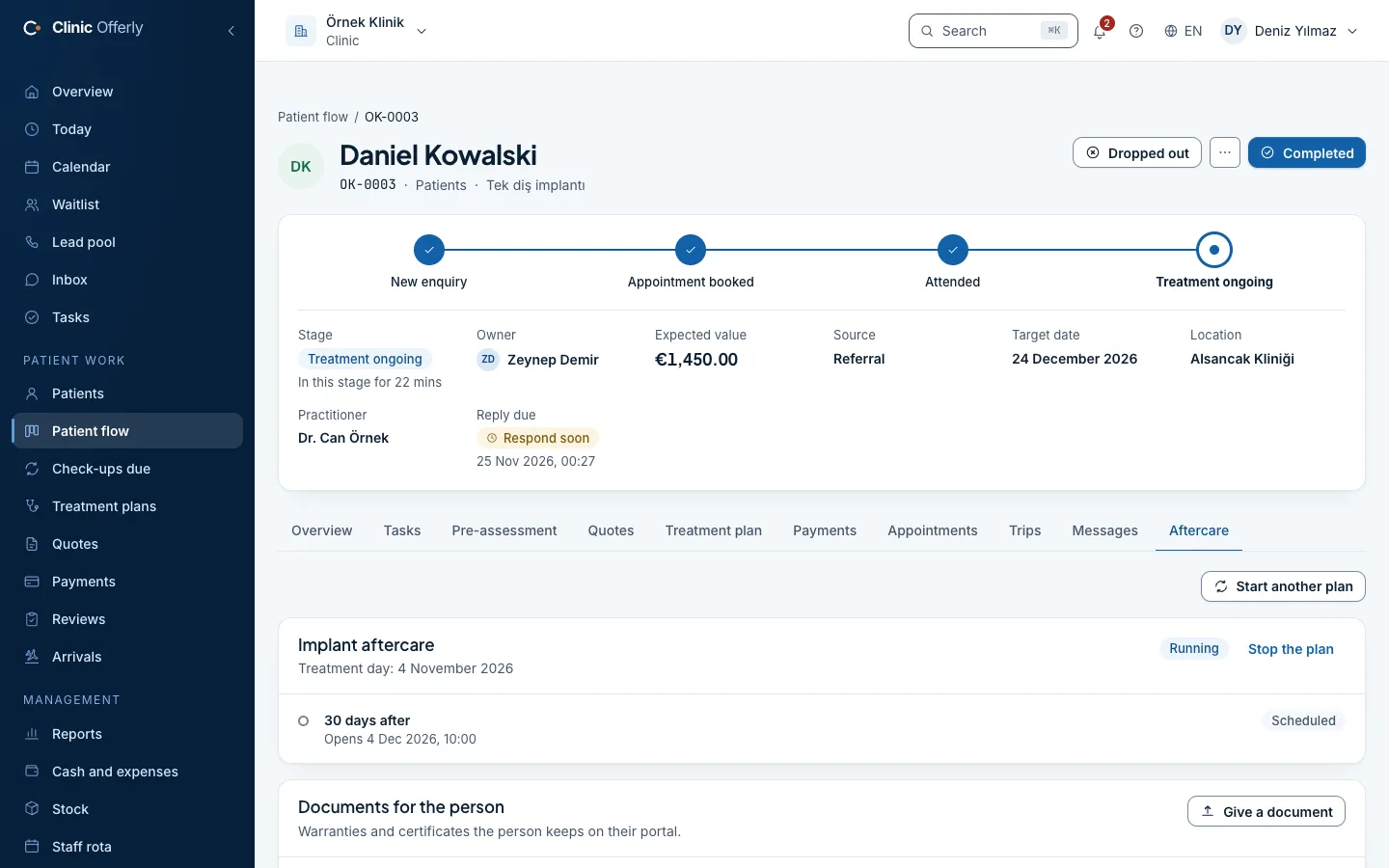
Follow-up plan
The due check-up lands with you as a task
When a plan's day comes the patient gets an e-mail and the case owner gets a follow-up task; the patient's answer shows on the case.
- Plan days by service
- Task and e-mail happen by themselves
- The patient answers on the portal
Frequently asked questions
How often should dental patients be recalled?
The dentist decides, and it varies with the patient's oral health. “Every six months” is a common suggestion but not a rule for your clinic. The clinic records the interval the dentist gave and reminds the patient when it is due.
Does a recall message need consent?
Information about the patient's own appointment and commercial messages fall under different rules. If you add prices, discounts or a new service, the message can become promotion and consent is needed; if it is borderline, ask your lawyer.
What should I do if a patient asks not to be contacted again?
Record the request and take the patient off the recall list. A request to withdraw marketing consent must be carried out within three working days (Law No. 6563, Article 8).
How many times should we try to reach someone?
One message and one call is a reasonable start. If the patient does not respond, do not keep pushing; leave a note for the next period.
Does Clinic Offerly do patient recall?
Yes, there is a Recalls screen: a service gets a check-up interval, completing an appointment creates the recall, and you send reminders in bulk or open tasks. The reminder is information; no campaigns, birthday or periodic greeting messages are sent.
Sources
- Law No. 6563 on the Regulation of Electronic Commerce, Articles 6 and 8 (Turkish text) — Mevzuat Bilgi Sistemi, Official Gazette, 5 May 2015
- Regulation on Promotion and Information Activities in Health Services, Article 5 (Turkish) — Official Gazette, 12 November 2025, no. 33075
- Regulation on Commercial Communication and Commercial Electronic Messages (Turkish) — Official Gazette, 15 July 2015, no. 29417
- Press statement on the Commercial Electronic Message Management System (İYS) (Turkish) — Ministry of Trade of the Republic of Türkiye, 30 November 2020
Stop check-ups from slipping through
Follow-up plans, tasks and a booking page together.
Related reading
30-day free trial
Try Clinic Offerly with your own team
Every feature is open for 30 days, and no card is needed to start.