How to move from a paper book or Excel to clinic software: a two-week plan
Published 23 October 2026Reviewed 23 October 20265 min read
On this page
Where do moves most often go wrong?
A move seldom fails for a technical reason; it fails because of habit. The team keeps going back to the old book, the data lives in two places and nobody knows which is current. That is why half the plan is moving data and half is settling who keeps what, where.
Moving patient information into software is processing personal data. Under Law 6698 you must keep data limited to its purpose, accurate and up to date, secure it and give notice. Health data is special-category data. See our guide on privacy for clinics for the detail.
What moves and what does not?
- Name, surname, phone, e-mail
- Moves?Yes
- NoteWrite phones in international form (+90…)
- Date of birth, nationality, language
- Moves?If needed
- NoteDo not move a field you do not need (data minimisation)
- Future appointments
- Moves?Yes
- NoteEnter one by one or import
- Open quotes and payment due dates
- Moves?Yes
- NoteWith the balance and due date
- Past appointments
- Moves?Optional
- NoteDo not move unless needed; keep them in the archive
- Diagnosis, treatment and examination notes
- Moves?No
- NoteClinic Offerly keeps no medical records; they stay in your own record system
- X-rays, reports, images
- Moves?No
- NoteSame reason
- Consent and notice documents
- Moves?Depends
- NoteCheck with your lawyer that existing consents remain valid
The two-week plan
Days 1-2: Name the owner and the scope
Choose one person to run the move. Write down what you will move and what you will not.
Days 3-4: Clean the sheet
Put it in one sheet: name, surname, phone, e-mail, source. Delete blank and duplicate rows, put phones in one format and make sure each row is one person.
Day 5: Review notice and consents
Does your privacy notice cover the software and where data is kept? Separate those with marketing consent from those without. You may need to update your VERBİS entry.
Days 6-7: Import
Try a small file (10-20 rows); see the mapping and the duplicate behaviour, then import the rest.
Day 8: Check duplicates
See whether the same person has two records; merge where needed.
Days 9-10: Train the team
A short exercise for each role: booking, marking arrival, notes, payment. Limit permissions by role.
Days 11-14: Run in parallel
Make the new system the single source of truth; keep the book only as a backup. Drop the book after a week.
Check before the move
- What to move and what not to move is written down
- The sheet is in one format: name, surname, phone (+90…), e-mail
- Blank and duplicate rows are deleted
- The privacy notice covers the new system and where data is kept
- Those with marketing consent are marked separately
- Permissions are set by role
- A trial import with a small file was done
- Retention of old records was confirmed with a lawyer or the provincial health directorate
How do you do it in Clinic Offerly?
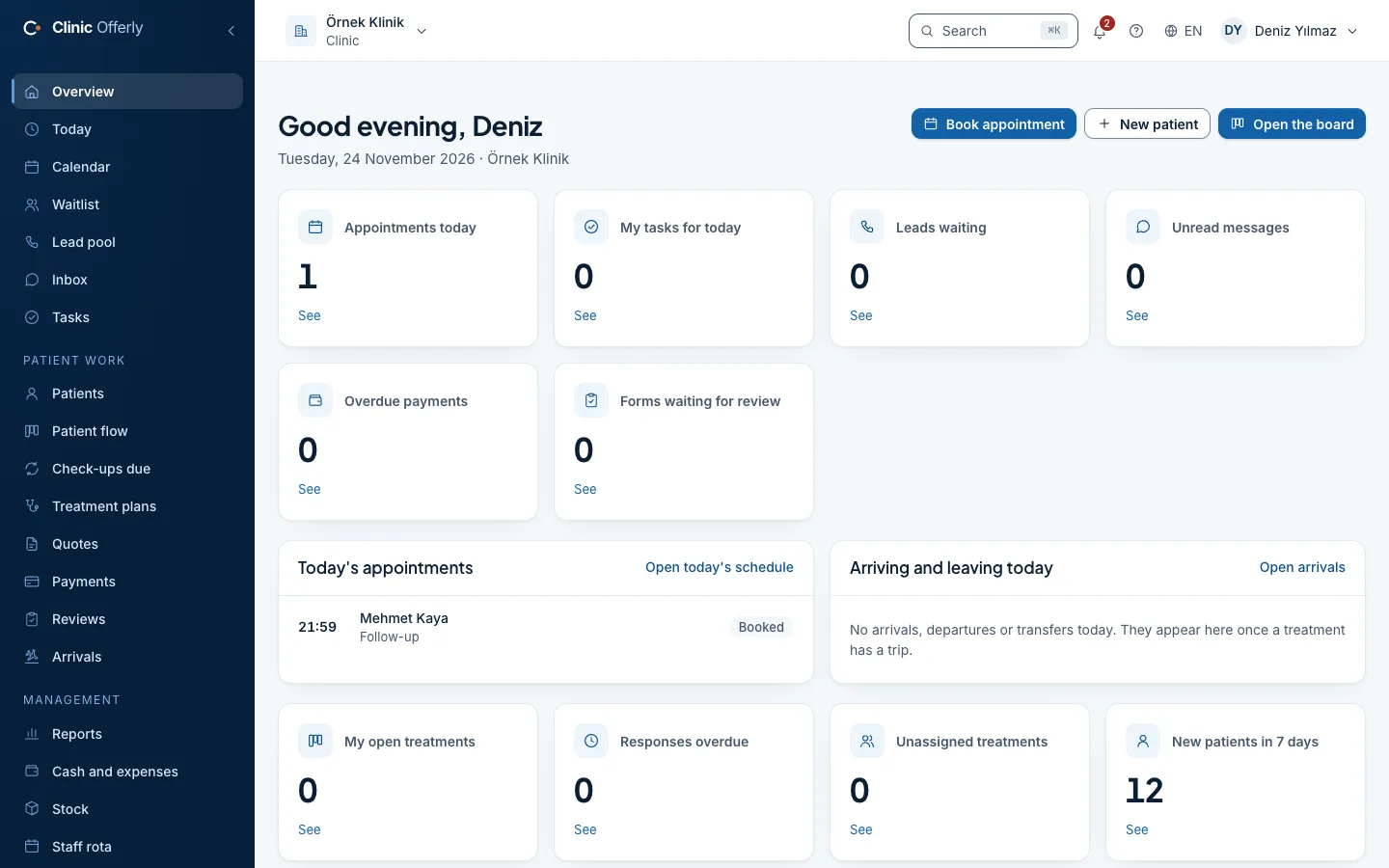
Clinic Offerly keeps no medical records; it carries contacts, contact details, appointments, quotes and payment records.
CSV or Excel (.xlsx)
Upload the file on the Contacts screen and map the columns to fields. Presets include spreadsheet, Kommo, Bitrix24 and HubSpot.
Duplicate contacts
The import can skip a contact with the same phone or e-mail, and you can merge duplicate records afterwards.
Open cases
If you import an opportunity list you can create an open case from each row.
Field minimisation
Fields such as date of birth, nationality, time zone and preferred channel can be switched off in the workspace.
Roles and visibility
Teams and visibility rules per role decide who sees which records.
Privacy tools
The compliance centre holds notice and explicit consent texts and data requests.
Frequently asked questions
How many patients should I move?
As many as you need to: active patients, open items and future appointments. Leaving out patients who have not come in years also fits the data minimisation principle.
Can I throw away the old paper files?
No, not before you know the retention period. The duty to keep health records sits in health legislation; ask the provincial health directorate and your lawyer.
Do I have to tell patients about the move?
If you use a new data-processing environment, update your privacy notice and tell patients where needed. The duty to give notice is in Article 10 of Law 6698.
What if the import goes wrong?
Try a small file first. Seeing the mapping and the duplicate behaviour before uploading the full file keeps mistakes small.
Does Clinic Offerly move my medical records?
No. Clinic Offerly keeps no diagnosis, treatment or examination notes, so there is no medical record import.
Sources
- Law No. 6698 on the Protection of Personal Data, Articles 4, 6, 10 and 12 (Turkish text) — Mevzuat Bilgi Sistemi
- VERBIS — Personal Data Protection Authority
From paper book to software in a week
Import with CSV or Excel, check duplicates and add the team with roles.
Related reading
30-day free trial
Try Clinic Offerly with your own team
Every feature is open for 30 days, and no card is needed to start.