What is an informed consent form and how do you prepare one? Under Turkish patient rights rules
Published 27 October 2026Reviewed 27 October 20267 min read
On this page
Is consent to treatment the same as explicit consent?
No. The two concepts rest on different laws and answer different questions. Consent in the Patient Rights Regulation (Article 4) is the person's free, informed acceptance of a medical intervention; the subject is bodily integrity. Explicit consent under Law 6698 (KVKK) is approval for processing personal data; the subject is the use of data.
So a consent form signed for an operation is not also a privacy notice or explicit consent for processing the patient's data. The privacy notice and the explicit consent are separate texts and should be kept separate. Decide with your lawyer which legal basis you rely on for which processing.
What does the regulation say?
The Patient Rights Regulation (Official Gazette, 1 August 1998, no. 23420; amended in 2014, 2016 and 2019) governs consent in these articles. The text can change; open the current version in the legislation database before you rely on it.
- Art. 4
- What it saysConsent is the person's free and informed acceptance of a medical intervention.
- Art. 15
- What it saysThe patient is told: the likely causes and course of the condition; who will perform the intervention, where, how and for how long; other diagnostic and treatment options with their benefits and risks; possible complications; the likely outcome of refusing; the important properties of the medicines to be used; lifestyle advice that matters for their health; and how to get help on the same matter again.
- Art. 18
- What it saysInformation is given in plain, understandable terms and verbally by the health professional who will perform the intervention. If the patient asks for information to go to someone else, that request is recorded in writing with their signature.
- Art. 20
- What it saysA patient may ask not to be informed, or that relatives not be informed, about their condition; the decision is recorded in writing.
- Art. 24
- What it saysMedical interventions need the patient's consent; for a minor or a person under guardianship the legal representative's permission is needed. In an emergency, where life is at risk and the patient is unconscious, consent is not required and the situation is recorded.
- Art. 25
- What it saysExcept where the law requires treatment, a patient may refuse or ask to stop it. The consequences are explained and a written document showing this is obtained.
- Art. 26
- What it saysFor interventions the law requires it for, or where a dispute is medically foreseeable, the facility prepares a consent form. Information is given verbally first, then the patient or legal representative signs; two copies are made (one for the file, one for the patient). The health professional who gave the information and performs the intervention also signs. Forms are archived under the archive rules.
- Art. 28
- What it saysExcept where the law provides otherwise, consent has no required form; consent obtained unlawfully or immorally is void.
- Art. 31
- What it saysConsent covers the routine steps that are part of the intervention; the intervention must stay within the scope of the consent.
How to prepare a consent form
Name the intervention clearly
Its name, who will perform it, where and roughly how long it takes should appear on the form (Art. 15).
Put the information the regulation lists on the form
Options, risks, complications, the consequences of refusing, medicine information and where to get help afterwards. The headings become the checklist for the verbal explanation.
Explain verbally, then have it signed
The health professional who will perform the intervention explains it in plain language, the patient asks questions, and only then is the form signed.
Make two copies
One stays in the patient's file, one goes to the patient or the legal representative. The health professional who gave the information signs too.
Record a refusal separately
If the patient refuses, explain the consequences and obtain a written document showing it (Art. 25).
Archive it
Keep the form with the patient file under your facility's archive and retention rules. Check the legislation that binds your facility for the retention period.
Common mistakes
- Using the form instead of the explanation: a signature does not cover a risk nobody explained.
- One catch-all “I agree to everything” text: consent is limited to the scope of the intervention (Art. 31).
- Having it signed in a language the patient does not understand, or in a rush: information must be given at a level the patient understands (Art. 18).
- Keeping a single copy: the regulation asks for two.
- Burying KVKK explicit consent in the consent form: take it as a separate text with a separate approval.
- No separate permission for photos or video: see the patient photos guide.
Where does Clinic Offerly fit?
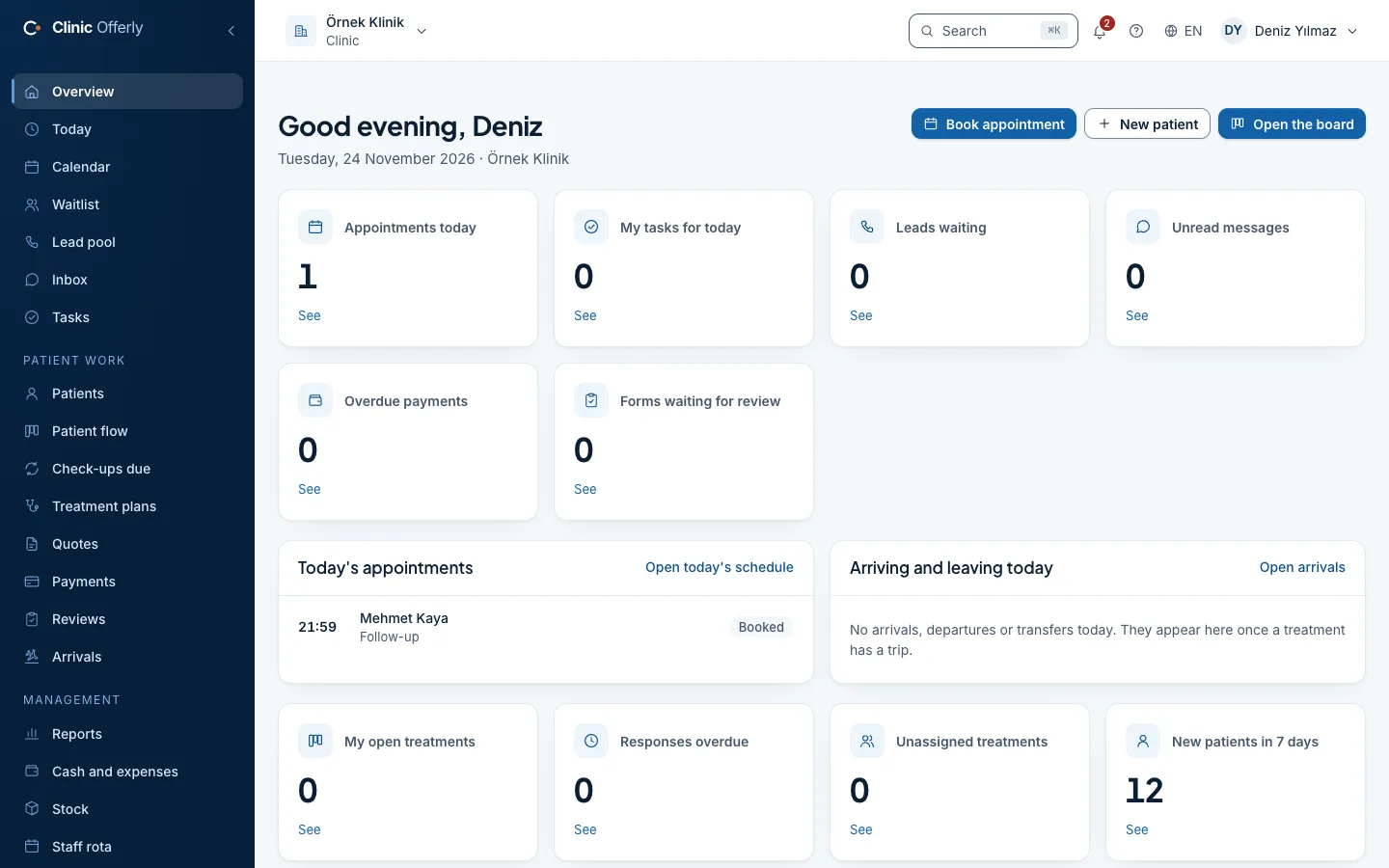
Clinic Offerly does not keep medical records; the consent form stays in your clinic's own patient file. What Clinic Offerly does is the administrative work around it.
Privacy notice and explicit consent
The compliance centre sets up the KVKK privacy notice and explicit consent texts from a template, publishes them in versions and records approvals. This does not replace consent to a medical intervention.
Intake form
Used to collect administrative information from a patient before an appointment; it is not a medical consent form.
Restricted access
You limit who can reach patient information with roles and visibility rules; actions are written to the activity log.
Frequently asked questions
Is a consent form mandatory?
The regulation asks the facility to prepare and have signed a form for interventions the law requires it for or where a dispute is medically foreseeable (Art. 26). Consent as such has no required form (Art. 28), but a written form is the practical way to prove it.
How many copies of the consent form are signed?
Two under the regulation: one stays in the patient file, one goes to the patient or legal representative (Art. 26).
Who signs the form?
The patient or legal representative signs; the health professional who gave the information and performs the intervention signs too and answers for the form (Art. 26).
What if the patient refuses?
The consequences are explained and a written document showing the refusal is obtained (Art. 25). For an intervention refused in an emergency the regulation provides for a signed refusal, or minutes if the patient declines to sign (Art. 26).
Whose consent is needed for a minor?
The legal representative's permission is needed for a minor or a person under guardianship, and the patient takes part as far as they can understand (Art. 24).
Can electronic approval replace a paper consent form?
The form rules follow the regulation. Electronic consent appears in the Ministry's draft; check the legislation database for the text in force. Clinic Offerly does not offer medical consent signatures.
Can a consent form and the KVKK privacy notice be combined?
We suggest not. Consent concerns the intervention, explicit consent concerns data processing and the notice is information. Take them as separate texts with separate approvals.
Sources
- Patient Rights Regulation (Articles 4, 15, 18, 20, 24, 25, 26, 28, 31), Turkish text — Legislation Information System (Mevzuat Bilgi Sistemi), Official Gazette, 1 August 1998, no. 23420; amended 8 May 2014, 23 December 2016 and 16 January 2019
- Law No. 6698 on the Protection of Personal Data (Articles 3, 6, 10), Turkish text — Legislation Information System (Mevzuat Bilgi Sistemi), Official Gazette, 7 April 2016; amended by Law 7499
Download the consent form template
A free Word template with fields in square brackets, to fill in and adapt with your lawyer.
Related reading
30-day free trial
Try Clinic Offerly with your own team
Every feature is open for 30 days, and no card is needed to start.