How to measure patient satisfaction: questions, NPS and handling complaints
Published 23 October 2026Reviewed 23 October 20266 min read
On this page
Why measure patient satisfaction?
Measuring satisfaction is not the same as chatting with patients: ask the same question regularly and you see change over time. Has waiting got longer, has a new receptionist made a difference, why do one practitioner's patients come back less? You can answer with figures, not scattered impressions.
Measurement is for the clinic. Publishing the results as advertising runs into Article 5 of the 12 November 2025 promotion regulation, which bans sharing patient thank-you and satisfaction messages as advertising. See our guide on patient reviews for the review rules.
Which questions should you ask?
Non-clinical questions about the clinic. Do not ask about diagnosis, treatment or health status: that is special-category data.
- Access and booking
- Sample questionHow easy was it to book your appointment?
- Answer type1-5
- Waiting
- Sample questionWere you seen at your appointment time?
- Answer typeYes / No / Partly
- Communication
- Sample questionWas what would be done explained clearly?
- Answer type1-5
- Team
- Sample questionHow satisfied were you with our team's attention?
- Answer type1-5
- Payment and paperwork
- Sample questionWas the payment and paperwork process clear?
- Answer typeYes / No
- Recommendation (NPS)
- Sample questionHow likely are you to recommend us to a friend or relative?
- Answer type0-10
- Why?
- Sample questionWhat is the reason for your score?
- Answer typeOpen text
How is NPS calculated?
NPS (Net Promoter Score) rests on one question: “How likely are you to recommend us to a friend or relative?” On a 0-10 scale, 9-10 are promoters, 7-8 are passives and 0-6 are detractors. NPS is the percentage of promoters minus the percentage of detractors, so it runs from -100 to +100. Fred Reichheld introduced it in the Harvard Business Review in 2003.
Example: if 30 of 50 answers are 9-10, 12 are 7-8 and 8 are 0-6, promoters are 60%, detractors 16% and the NPS is 44. Whether NPS predicts growth is disputed, and it does not by itself tell you what to fix; read it together with the open “why?” answers.
When and how to ask
- The day after the visit
- ChannelE-mail or the channel the patient uses
- NoteWhile the impression is fresh; keep it short
- At the post-treatment check
- ChannelFollow-up message
- NoteAbout the service experience, not the treatment result
- At the desk, in front of staff
- Channel—
- NoteAvoid: patients may not answer honestly
- Once a year
- ChannelAll patients
- NoteCompare with the previous period
What do you do when a negative answer or complaint arrives?
Log it and name an owner
Every complaint is a record and has an owner. Write down verbal ones too.
Reach out and listen
Set a target time (for example one working day) and show by phone or in writing that you listened first. Do not get defensive.
Establish the facts
Find out what happened by talking to the people involved. If it concerns a practitioner's clinical decision, pass it to the practitioner.
Reply
Tell the patient in writing what you learned and what you will do.
Fix the root cause
If the same complaint comes up three times, the process is at fault, not a person.
Call the patient back
Ask a while after the fix how things are; closing the loop matters to the patient and to your records.
How do you do it in Clinic Offerly?
Clinic Offerly has a post-visit survey; its results are visible only to the clinic and are never published.
The post-visit survey
Switch it on in Settings → Feedback. When an appointment is completed, the patient gets a link after the delay you choose, in their language (by e-mail, or by SMS or WhatsApp if connected). It asks for a 0-10 recommendation score (NPS), optional ratings for practitioner, staff, waiting time and cleanliness, and a comment; you cannot add your own survey questions. There is no reward or incentive for answering.
A low score becomes a task
A score of 0-6 (an optional setting) creates a task and a notification for the case owner, so the first step of handling a complaint starts by itself. The “not good” and “call me” answers in aftercare check-ins open tasks too.
The Feedback screen
NPS, response rate, rating averages and the trend over time by practitioner, service and location; comments filter by score and the list downloads as CSV. Results are not shown to patients or on your website.
Your own review page
If you wish, a plain link to your own Google (or other) review page is shown to everyone who answers, alike; there is no filtering by score and no incentive.
Follow-up
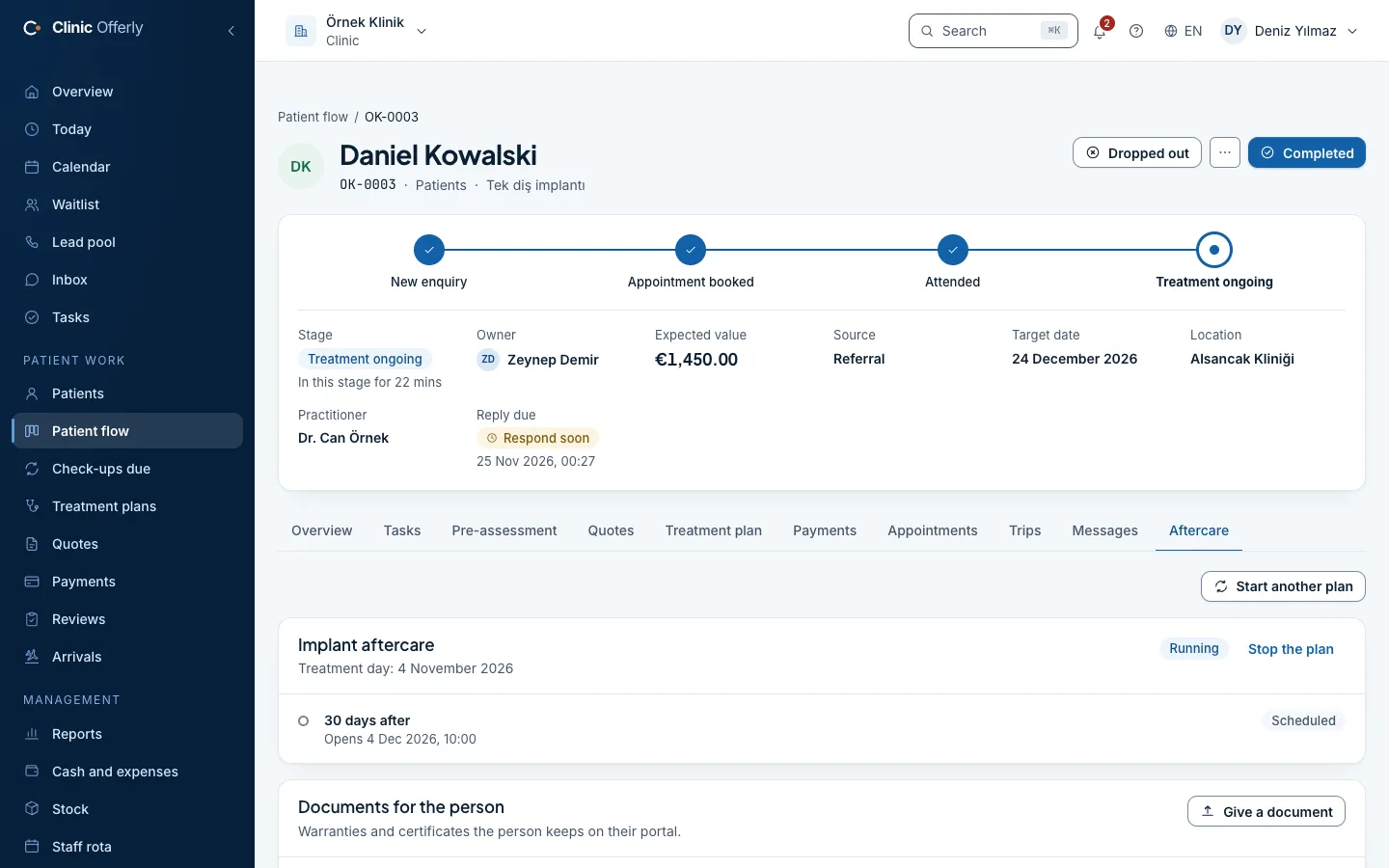
A patient saying “not good” becomes a task
The follow-up check-in reaches the patient by e-mail; a negative answer or a “call me” choice lands with the case owner as a task.
- Fixed, non-clinical questions
- Task and notification happen by themselves
- The patient can answer on the portal too
Frequently asked questions
What is a good NPS?
There is no threshold that applies to everyone; it varies by specialty, country and survey. Measure your own score the same way each period and watch the change.
Should the survey be anonymous?
An anonymous survey may bring more honest answers, but you cannot respond to a negative one. If you collect names, tell patients the purpose and how the data will be used (the privacy notice), and ask no medical questions.
Can I publish satisfaction scores on my website?
Sharing patient thank-you and satisfaction messages as advertising is banned (the 12 November 2025 regulation, Article 5). Keep the measurement inside the clinic.
How fast must I respond to a patient's complaint?
The regulation sets no deadline for the facility's own reply; the patient rights board decides applications the facility could not resolve within 30 days. Set your own target, for instance a first reply within one working day.
Does Clinic Offerly run satisfaction surveys?
Yes. When an appointment is completed the patient gets a link asking for a 0-10 NPS score, optional ratings and a comment; results are visible only to the clinic and are never published. Custom survey questions cannot be added.
Sources
- Patient Rights Regulation, Articles 2, 42 and 42/A to 42/C (Turkish text) — Official Gazette, 1 August 1998, no. 23420; text with the 2014, 2016 and 2019 amendments
- Regulation on Outpatient Private Health Facilities, Article 34 (Turkish text) — Official Gazette, 19 April 2025, no. 32875
- Regulation on Promotion and Information Activities in Health Services, Article 5 (Turkish) — Official Gazette, 12 November 2025, no. 33075
- Net promoter score — Wikipedia
Do not lose a negative answer
Follow-up check-ins and tasks let you get back to the patient in time.
Related reading
30-day free trial
Try Clinic Offerly with your own team
Every feature is open for 30 days, and no card is needed to start.