Is a Turkish clinic subject to GDPR?
Published 23 October 2026Reviewed 23 October 20267 min read
On this page
When does the GDPR apply to a clinic in Türkiye?
The GDPR can reach an organisation in Türkiye by two routes. The first is Article 3(1): if you have an establishment (a branch or office) in the EU and the data is processed in the context of that establishment's activities, it applies whatever the nationality or location of the person.
The second, for organisations established in Türkiye with no EU establishment, is Article 3(2): (a) offering goods or services, paid or not, to people in the EU, or (b) monitoring their behaviour within the EU. The European Data Protection Board's Guidelines 3/2018 explain this test.
Indicators of targeting
According to EDPB Guidelines 3/2018 no single criterion decides; the indicators are read together.
- The website being accessible from the EU
- Points to targetingNaming the EU state where the service is offered
- An e-mail address or contact detail being visible from the EU
- Points to targetingSearch-engine advertising or campaigns aimed at the EU
- Using your own country's language
- Points to targetingContent in EU languages, prices in an EU currency
- An EU patient who turns up by chance
- Points to targetingA dedicated EU phone number, an EU domain such as .de
- Points to targetingTravel instructions from EU countries; an international clientele from EU countries; the international nature of some tourist activities
Where does health tourism sit in this?
The Guidelines discuss a Turkey-based website offering photo albums in EU languages and in euros (example 14): it falls under Article 3(2)(a) and must designate an EU representative. The same logic applies to a health tourism clinic with German and Dutch pages, euro packages and advertising aimed at the EU.
By contrast, a clinic serving patients from its own country that is occasionally written to by someone from the EU is not deliberately offering services to the EU; the Guidelines treat incidental and inadvertent service as out of scope.
KVKK and the GDPR side by side
- Health data
- KVKKSpecial category data (Art. 6)
- GDPRSpecial category (Art. 9); Art. 9(2)(h) and 9(3) for care, or explicit consent
- Legal ground
- KVKKArt. 5, and Art. 6 for special category data
- GDPRArt. 6, and Art. 9 for special categories
- Answering requests
- KVKK30 days, free of charge (Art. 13)
- GDPROne month, extendable (Art. 12)
- Breach notice
- KVKKTo the person and the Board as soon as possible (Art. 12(5))
- GDPR72 hours to the authority (Art. 33)
- Registry
- KVKKVERBİS, for controllers who must register (Art. 16)
- GDPRNo registry; a record of processing activities (Art. 30)
- Transfers abroad
- KVKKArt. 9: adequacy, appropriate safeguards, incidental transfer
- GDPRChapter V: adequacy, safeguards such as standard clauses
- EU representative
- KVKKNot covered by this comparison
- GDPREU representative for non-EU controllers who target (Art. 27)
- Sanctions
- KVKKArt. 18 administrative fines; amounts revalued every year
- GDPRArt. 83: up to 10 million euro or 2%, and up to 20 million euro or 4%
Is an EU representative mandatory, and who can it be?
Under Article 27 an organisation within Article 3(2) must designate in writing a representative established in one of the member states where its patients are. The representative's contact details go in your privacy notice. The exception is processing that is occasional, does not include large-scale special category data and is unlikely to put rights and freedoms at risk. The EDPB reads occasional as not regular and outside the regular course of business, so a clinic that processes health data regularly cannot rely on it.
Going without one is sanctionable: Article 83(4) allows administrative fines of up to 10 million euro or 2% of worldwide turnover, Article 27 included.
What if data comes to you from the EU?
According to EDPB Guidelines 05/2021, when a controller in a third country collects data directly from a person in the EU under Article 3(2), that is not a transfer under Chapter V. But when an EU clinic or agency sends patient information to a clinic in Türkiye, that is a transfer, and the sender must use a tool such as standard contractual clauses. That is why EU partners will ask you for a contract.
Step by step: assess yourself
Map your EU-facing work
German, French or Russian pages? Euro prices? Advertising in the EU? EU agencies? Yes answers are targeting indicators.
Decide whether you target
Read the indicators together and write down your reasoning; an occasional chance patient is not enough.
Appoint a representative
If you target, choose one established in the member state where your patients are, and add the contact details to your privacy notice.
Write down the basis for health data
Art. 9(2)(h) and 9(3) for treatment, explicit consent (Art. 9(2)(a)) for extras such as promotion and photos; keep a record.
Prepare the processes
A 72-hour breach notification plan, a way to answer requests within a month, and a record of processing activities.
Sign with EU partners
If data will come from the EU, tie a transfer tool such as standard clauses into the contract.
How it is done in Clinic Offerly
Choose the patient languages
Settings, Patient portal: the patient side speaks German, Arabic, Russian and French as well as Turkish and English. The languages you switch on are also a record of who you serve.
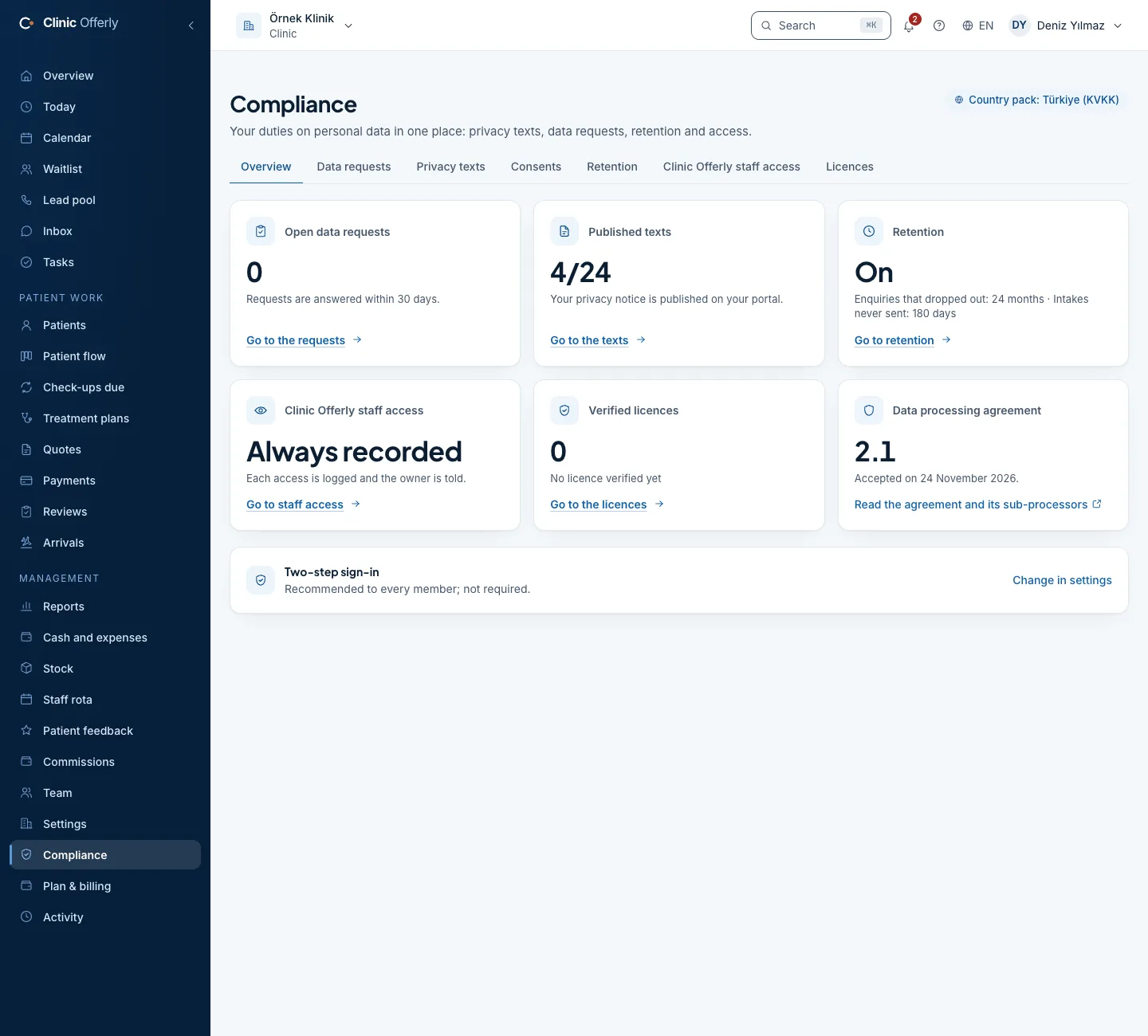
Use the country pack in the compliance centre
On the contact screen, “rules that apply to this person” shows the workspace pack together with the rules of where the person lives.
Publish the texts from templates
Privacy notice, explicit consent, photo and marketing consent texts come from templates, are versioned and publish in the portal.
Answer requests with due dates
Data requests run in one flow with a due date: a copy of the person's data (zip), restriction, objection, rectification, erasure and notifying the person.
Limit team access
Two-step sign-in, visibility per role and an append-only activity log. Data is held on servers in Germany; the Türkiye pack describes this as an Article 9 transfer.
The compliance centre
Frequently asked questions
People open my website from the EU. Am I subject to the GDPR?
No, accessibility alone is not enough. According to the EDPB, a website visible from the EU, an e-mail address or your own country's language does not amount to targeting on its own. Indicators such as EU languages, euros and advertising aimed at the EU are looked for together.
I have a few German patients a year. Do I need a representative?
If you do not deliberately offer services to the EU and patients arrive by chance, you may be out of scope. If you publish German-facing content and advertising, that is targeting, and because you process health data regularly you cannot rely on the Article 27 exception.
If I comply with KVKK, do I need anything more for the GDPR?
They overlap in part but are not the same. The GDPR adds requirements such as a representative, a record of processing activities, 72-hour notification, a one-month response time and transfer tools.
What is the ground for processing health data under the GDPR?
Usually Article 9(2)(h) with Article 9(3) (a health professional under a duty of secrecy), or the person's explicit consent. Record which one you rely on.
Is there a GDPR adequacy decision for Türkiye?
This page makes no claim about that; set your transfer tools by current Commission and EDPB publications and with your lawyer.
How large can the fines be?
Under Article 83 of the GDPR, up to 10 million euro or 2% for obligations such as Article 27, and up to 20 million euro or 4% for breaches of the basic principles and data subject rights. KVKK fines apply separately, with amounts revalued every year.
Sources
- Regulation (EU) 2016/679 (GDPR), Articles 3, 9, 12, 27, 33 and 83 — EUR-Lex, 27 April 2016
- Guidelines 3/2018 on the territorial scope of the GDPR (Article 3), version 2.1 — European Data Protection Board (EDPB), 12 November 2019
- Guidelines 05/2021 on the interplay between Article 3 and Chapter V, version 2.0 — European Data Protection Board (EDPB), 14 February 2023
- Law No. 6698 on the Protection of Personal Data (Turkish text) — Mevzuat Bilgi Sistemi, Official Gazette, 7 April 2016; as amended by Law No. 7499
Welcome EU patients in an orderly way
Patient languages, versioned consent texts and data requests in one place.
Related reading
30-day free trial
Try Clinic Offerly with your own team
Every feature is open for 30 days, and no card is needed to start.